

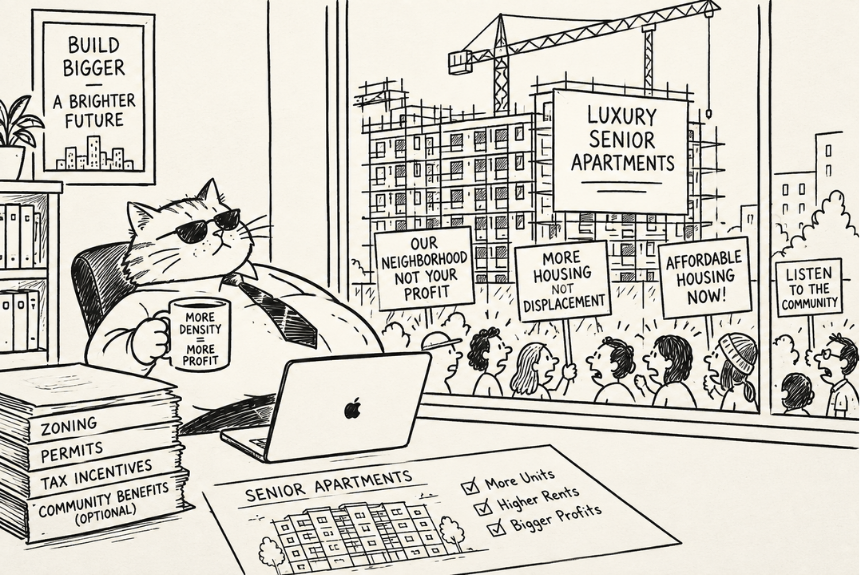
There’s a housing crisis in California. It’s overwhelmingly a crisis of affordability—working people of moderate income can’t find affordable apartments (leave aside homes). The governor and legislature say that state housing laws are designed to address that crisis, but they are slanted in favor of real estate developers.
Take the State Density Bonus Law (SDBL). It’s supposed to stimulate more affordable housing by providing density bonuses for developers who include some affordable units. But it turns out that developers need only include a small number of such units, and those rents can be near or even above market rates.
And senior housing developments do not need any affordable units at all to be covered by the SDBL and receive a 20% density bonus plus the waiver of local zoning regulations on height and overall size. Small wonder that we’re seeing luxury high-rise senior housing with no affordable units being planned for 6230 Claremont and for the Trader Joe’s site (and with more in the pipeline).
Laws Subject to Interpretation
But state housing laws are not solely responsible for the massive buildings coming to Rockridge (and Oakland). The city bears some responsibility. There’s an interaction between onerous state housing laws and the city’s interpretation of those laws that makes the combination worse than the sum of its parts.
For example, consider 6230 Claremont Avenue, where Ellis Partners and Spirit Living Group want to build an 85-foot-high, 203-unit Residential Care Facility for the Elderly. By our calculations (https://www.rockridgevoice.com/maximum-allowable-units-getting-the-math-right/), local zoning code, properly applied, allows only about 170–180 units there, even after applying the 20% SDBL density bonus for senior housing.
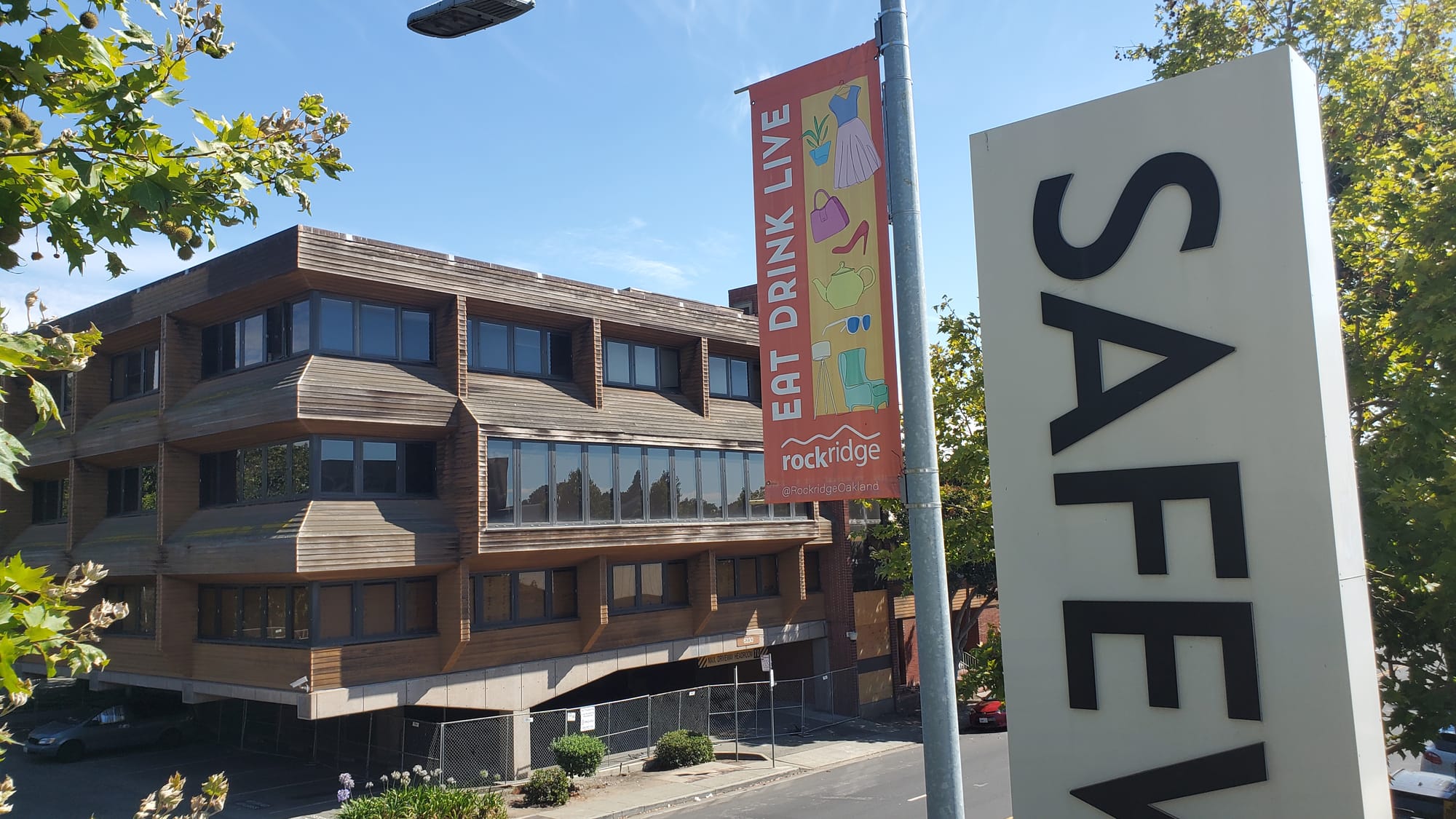
But Planning Department staff, by misapplying local zoning regulations, concluded that the developers are entitled to as many as 304 units there. That’s 50% more than the developers asked for and 75% more than the 170–180 units that should be the maximum allowed at the 6230 Claremont site. It would enable a building more than 125 feet high!
How did planning staff arrive at 304 units?
First, they applied the high Neighborhood Center Mixed Use densities. But these require a commercial component (with a preference for ground-floor retail shops) and a strong pedestrian orientation. The 6230 Claremont proposal has none of these: it's strictly a closed residential facility, with no commercial component, no ground-floor retail, and nothing open to the public.
Second, planning staff applied a gross-area-to-net-area conversion factor, increasing the number of units allowed by 33%. Staff justified this by citing their Zoning Code Bulletin. But that bulletin says that the conversion factor doesn’t apply to most districts in the city, and specifically says that it doesn't apply to CN districts (the zoning for 6230 Claremont, for the Trader Joe's site, and indeed for the whole College Avenue corridor).
Who’s Accountable?
We need to demand that our elected officials do all that they can to fix the immense problems with local and state housing laws and policies. We need state legislators to return more control over housing policies to local communities, while strengthening provisions that reward affordable housing—especially for those with low and moderate incomes (our state assemblymember, Buffy Wicks, and our state senator, Jesse Arreguin, are two of the most prominent proponents of the current state housing laws).
And we need our local representatives to do all they can to ensure sensible housing policies — not misapply and misinterpret zoning codes in the interest of maximizing developers’ profits at the expense of the community.
Otherwise, for all the bashing of Rockridge as well-off and exclusionary by YIMBYs and the SF Chronicle, we will get oversized buildings like those proposed for 6230 Claremont and the Trader Joe’s site, that will only make the neighborhood older, whiter, and richer.


