

I live on Auburn Avenue—6230 Claremont Avenue, the abandoned former site of the Red Cross Blood Bank, is right over my backyard fence.
As many readers already know, real estate developers Ellis Partners and Spirit Living Group want to build a massive Residential Care Facility for the Elderly on the site—85 feet high with 203 units.
The State Density Bonus Law, as amended in 2024, allows senior care facilities (even those that provide no affordable units, such as 6230 Claremont) to receive a 20% density bonus above local zoning limits—boosting maximum height to 66 feet, still well short of the proposed 85 feet.
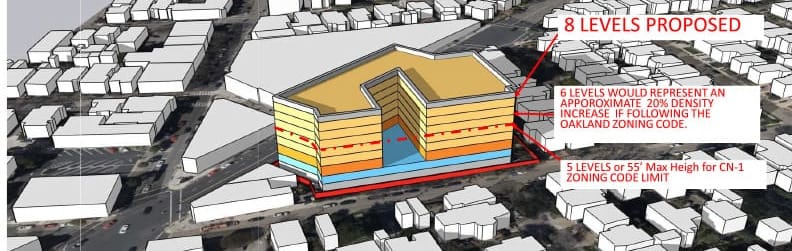
When I first heard about these plans last fall, my immediate reaction was: “How can they build something this big? Doesn’t Oakland zoning code require buildings on that block to be much smaller?” That is also a question many people have asked me.
Well, yes, 6230 Claremont is in a CN-1 local zoning area, which specifies a maximum height of 55 feet, and a footprint limited by required setbacks from neighboring properties as well as step-backs of 1 foot back for every foot of height over 30 feet. The State Density Bonus Law, as amended in 2024, allows senior care facilities to receive a 20% density bonus above local zoning limits – boosting maximum height to 66 feet, well short of the proposed 85 feet.
However, other state laws – especially the Housing Accountability Act and SB 330 – stipulate that a city must allow developers to build to the maximum number of units allowed for the site as determined by local zoning code plus any applicable state bonuses by granting any density-related waivers (on height, setbacks, etc.) – unless granting the waiver would result in a specific adverse impact to public health or safety.
The state laws set a high bar for demonstrating such adverse impact, and specify large fines should the state deem that a city incorrectly denied a waiver (even if denied in good faith).
So, while there are real concerns about the hazard to public health and safety of the proposed 6230 Claremont project — increased seismic risk, deprivation of sunlight, and traffic safety — the city is not likely to deny waivers on those grounds. (Litigation is still a possibility, though.)
But even if no adverse impact to public health or safety is deemed to have been shown, the waivers should not be granted. The waivers explicitly depend upon the correct determination of maximum allowable units.
For 6230 Claremont, the developers, via their attorneys (Coblentz et al), assert that their planned 203 units are well below the maximum number of allowable units for the site. But they misinterpret and misapply Oakland’s local zoning codes in their calculation of maximum allowable base density, thus grossly overestimating the maximum number of units allowable for this site.
Their approach is flawed in two ways before state density bonuses are even applied:
- It relies on a false zoning premise that inflates the base density by over 32%.
- It misinterprets and/or misapplies the clearly specified instructions from the city’s Zone Coding Bulletin, resulting in compounding the overestimation.
Consequently, after applying the 20% density bonus, the developers claim to be entitled to 70% more units than those specified by local zoning codes, when in fact they are only entitled to at most 20% more (via the state density bonus.)
Misapplication of NCMU Standards
The biggest error is the false premise that the project is entitled to the maximum allowable densities designated for Neighborhood Center Mixed Use (NCMU) under the Land Use and Transportation Element (LUTE, p. 149). Without that 32% boost, the developers would fall far short of the 203 units that they claim, even after applying the state density bonus.
Here’s what LUTE says about Neighborhood Center Mixed Use: “Future development within the classification should be commercial or mixed uses that are pedestrian-oriented and serve nearby neighborhoods, or are residential with ground floor commercial.”
The proposed facility meets none of these criteria: There is no commercial component (it is entirely residential). It is not pedestrian-oriented (there are no ground floor shops; all amenities are restricted to residents and not open to the public.) This is a purely closed, residential facility.
Consequently, the NCMU densities (165–330 units/acre) do not apply. The project must instead utilize the densities specified in Table 17.33.04 of the Oakland Municipal Code for a 55-foot building in a CN-1 zone: 1 unit per 350 sq. ft. for regular units (~124.5 units/acre) and 1 unit per 175 sq. ft. for rooming units (~248.9 units/acre). Then, we find that the project only qualifies for at most 177 units – 26 units less than the number they propose. (See the Addendum for calculation details.)
Conclusion
Because the “Base Density” is artificially inflated by the misapplication of the code for Neighborhood Center Mixed Use, the project does not qualify for the 203 units requested. Because the project exceeds the maximum allowable density even after applying the State Density Bonus, the applicants’ requests for density-contingent waivers (height, setbacks, stepbacks, etc.) should be denied. We hope and expect that the Planning Department, which must rule on the project’s zoning compliance by June 22nd, will agree.
APPENDIX: Correcting the Calculations
The city’s Zoning Code Bulletin (revised March 20, 2024, page 3) specifies two different formulas for calculating maximum allowable density in residential developments that include both regular dwelling units and smaller (efficiency and rooming) units. The two formulas are mathematically equivalent. One is recommended when the number of smaller units is known; the other is recommended when the percentage, but not the number, of smaller units is known.
In their letter to the Planning Department dated March 16, Coblentz et al (attorneys for the developers) submitted their calculations for three different scenarios differing in the number of small (efficiency and rooming units) proposed: none in scenario 1; 24 in scenario 2; 35 in scenario 3. Since in all three scenarios the number of smaller units is known in advance, the appropriate formula, as specified in the Zoning Code Bulletin, is:
Max Units = (Base Regular Units Allowed) + (Density edu / Density rdu)(n),
Where:
- Base Regular Units Allowed is the maximum number of units allowed for the site if all units are regular (full size) units
- n is the total number of efficiency and rooming units proposed,
- density rdu and density edu are the respective maximum allowable densities for regular dwelling units and for smaller (efficiency and rooming) units.
As noted above, the correct densities are those specified in Table 17.33.04 of the Oakland Municipal Code for a 55-foot building in a CN-1 zone: 1 unit per 350 sq. ft. for regular units and 1 unit per 175 sq. ft. for rooming units.
Therefore Density edu / Density rdu = 175/350 = 0.5, and
Max Units = (Base Regular Units Allowed) + (0.5)(n)
Base Regular Units Allowed = (Area of site) / (Density of regular dwelling unit) = 46,473 sq. ft. / (350 sq. ft. per unit) = 132 units.
For scenario 1, Max Units = 132 + 0.5 times 0 = 132 units. Applying the 20% state density bonus yields 0 smaller units, 159 regular dwelling units, for a total of 159 units.
Before doing the calculations for scenarios 2 and 3, we must first adjust n, the number of smaller units, as detailed in the Zoning Code Bulletin: In scenario 2 they specify 24 efficiency or rooming units after applying the 20% state density bonus. In scenario 3 they specify 35 rooming units after applying the 20% state density bonus.
Adjusting for this: n = 20 for scenario 2, and n = 30 for scenario 3.
For scenario 2, Max Units = 132 + 0.5 times 20 = 142 units. Applying the 20% state density bonus yields 24 smaller units and 147 regular dwelling units, for a total of 171 units.
For scenario 3, Max Units = 132 + 0.5 times 30 = 147 units. Applying the 20% state density bonus yields 35 smaller units and 142 regular dwelling units, for a total of 177 units.
The developers are entitled to at most 177 units, 26 fewer than the 203 that they claim.


