

Oakland’s Planning Department is developing, for City Council approval, a new General Plan for how land will be used in the City. The proposed Plan will replace the Rockridge neighborhood with a transit hub “similar to present-day Broadway,” with 95-foot-tall buildings surrounding the BART station, a mix of residential and commercial uses lining College Avenue, and ground floor amenities such as retail and public spaces.”
Revisions to the original General Plan, adopted in 1998, were precipitated by the passage of new housing laws (SB 330 and SB 79). In SB 330, adopted in 2019, the Legislature declared there was a housing crisis with “housing demand far outstripping supply” causing housing to “become very expensive.” “A key factor” in its enactment was to increase the supply of housing “affordable to Californians of all income levels.”
SB 330 required Oakland to determine how much housing was needed in the City, how Oakland would meet those needs, and to create “an inventory . . . of land suitable for residential development.” Then, Oakland was required to develop a plan for where new affordable housing would be built.
Option 1 or Option 2?
Oakland responded by making two plans, one for the period 2023-2031 (to satisfy deadlines in the statute), and a second that covers the period from 2031-2045. Oakland’s Phase 1 plan was approved in 2023 by the Department of Housing and Community Development which oversees implementation of SB 330.
It says “Key principles in this Plan encourage development that respects and supports the distinctive neighborhood orientation of Oakland,” and the City plans to “[c]reate more livable and walkable neighborhoods where folks have access to the things they want and need, like grocery stores, arts & entertainment, retail, libraries, and parks.” Diversity is “supported by this Plan as one of the key qualities that makes Oakland special, attractive, and livable.”
In choosing properties for new housing under existing zoning, the Housing Element of the approved Phase 1 plan, describes “a plan to expand housing options in more affluent neighborhoods and reinvesting in less affluent neighborhoods [t]o affirmatively further fair housing for all Oaklanders.” The purpose was to “[e]ncourage new affordable housing in higher resource neighborhoods… that were formed through exclusionary policies,” like single-family zoning. Group discussions included “changing the zoning to increase density in single-family areas like Rockridge.” (1 Government Code § 65589.5(a)(2).)
Although a framework for updates to the approved General Plan (Phase 2) stated that “engagement is at the heart of Oakland’s GPU process. Community voices are central to every step of this process — from setting a shared vision to creating policies that reflect the needs, values, and priorities of all Oaklanders. It appears however that community input has been superseded by state mandates.
A report (see Section 2, pp 7-8) was published after a survey of Oakland residents was conducted to identify which of two options for “How We Stabilize and Grow” they preferred.
Option A aims to increase neighborhoods’ self-sufficiency by adding more employment and commercial uses within easy walking and biking distance from people’s homes.
Option B proposes that a significant amount of Oakland’s residential and employment growth take place in focused areas along the City’s main transportation streets, or corridors, where redevelopment potential is highest. The major thoroughfares are identified as Broadway, College Avenue, Telegraph Avenue, Grand Avenue, San Pablo Avenue, McArthur Boulevard, International Boulevard, and Hegenberger Road. The Rockridge BART station is specifically mentioned.
The Legislature chose Option B through new legislation.
SB 79, which went into effect on July 1, 2026, establishes housing standards that replace and override local zoning maps and the wishes of locally elected officials and residents. The BART Station has been designated a transit-oriented development (TOD) stop.
Height and density standards are “based on how close a property is to a transit-oriented development stop for trains and rapid bus lines. A map prepared by the Metropolitan Transit Authority shows the area subject to its provisions, a circle with a radius of one-half mile around the BART station.
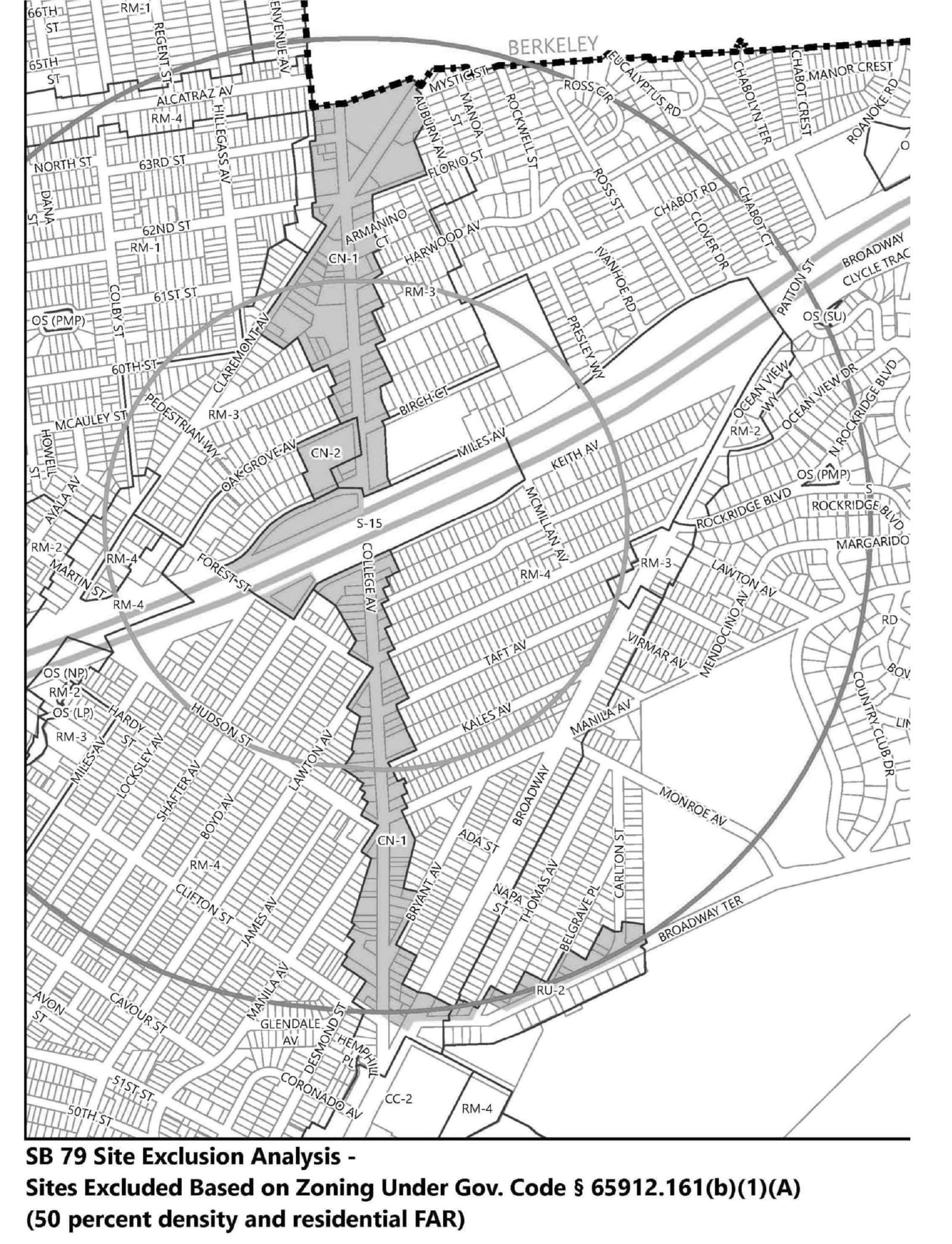
The circumference appears to include at its outer edges, going clockwise, the intersection of College and Alcatraz to the north; Highway 24 Exit at College Avenue on the east; the intersection of Broadway and College to the south; and the intersection of Telegraph Avenue and 58th Street to the west.
SB 79 allows 95-foot-tall (9-10 story) buildings to surround the Rockridge BART station if they are within 200 feet, up to 75 feet within a quarter-mile, and up to 65 feet (approx. 6 stories) if located within a half-mile. College Avenue was determined to be a “transit corridor” along which additional residential and commercial growth will occur.
Planners explained that although College Avenue might be thought of as a “minor corridor,” as opposed to “major corridors” like International Boulevard, it is expected to grow to include new mid-rise development, wider streets and greater “commercial density… better able to support taller buildings.”
Our representative in the California Assembly, Buffy Wicks, said at the hearing on SB 79:
“I eagerly look forward to seeing this bill succeed…and I think that’s what this bill would do in terms of allowing for [denser] housing. When you stand at the Rockridge BART, you look across the street and there’s Zachary’s. There’s the Trader Joe’s. Those are single-story buildings, essentially. And that is at exactly the type of place where we should be building taller, more densely right there on the BART stop. So, those are the types of things I think that we should absolutely be doing, is to ensure we have more housing and housing at all different types.”
Did she speak for the community she represents?
Oakland has the option “to adopt an SB 79 ordinance and/or Transit Oriented Development (TOD) alternative plan to modify certain SB 79 applicable sites or development standards, provided the ordinance or plan meets the applicable statutory requirements.”
The alternative plan must be approved by the Housing and Community Development Department, which oversees compliance with SB 79. Local planners have discussed possible alternative plans with the Department and have been turned down. They believe the only way to change Rockridge’s fate is to persuade legislators to amend the statute, in particular the authors, Scott Wiener and Buffy Wicks.


