


When you visit Tom Chantler in his Rockridge garage workshop, you’ll see a large workbench surrounded by drawers of tools and supplies, which provide the perfect space to work on his steady stream of creative endeavors.
“I get so lost in all this that I’ll look up and it’s late, and I haven’t had dinner,” he says. “That's just the best feeling of all because you’re immersed in what you’re doing.”
Tom is an artist and earned his degree in industrial design at Ohio State. He worked on designing spas, furniture, and even bicycling accessories, but eventually, spent most of his career doing voice-overs for video games, radio and TV commercials. Known for his comedic style, Tom brought wit, timing, and personality to many of his performances—from Google to the SF Opera, Clorox, Honda, Kia and Tillamook cheese.

While voice acting may sound effortless, Tom says it requires far more preparation than most people realize. Even so, he says that it rarely felt like work. He found the environment intensely creative where comedians, actors, writers, and other artists constantly exchanged ideas—making every project feel fresh and collaborative.
At the time he got into the industry, it was still relatively new, allowing him to build a successful career doing work he loved for nearly two decades. He later served on the national board of directors for the Screen Actors Guild, though he notes the industry has changed dramatically. Today, much of the work is non-union, and virtually anyone with a computer and microphone can enter the field.
Long before his acting career, Tom learned to fly-fish alongside his father. The pastime taught him more than patience—it instilled a lifelong appreciation for craftsmanship.
“My dad was an inveterate fly fisherman, as were my brother and I,” he says. “We couldn't have escaped it if we wanted to, but we loved it. That meant tying your own flies and fixing your gear when it broke. There was a handmade aspect to that pursuit.”
That appreciation for making things by hand led him to discover the work of Alexander Calder. Inspired by Calder’s mobiles, Tom bought one of his books and began experimenting with wire sculptures, teaching himself the techniques through trial and error. Friends who received his early pieces encouraged him to sell them on eBay.
“I looked on eBay and there were plenty of people using Calder's name and selling things that looked like Calder," he says. “So that's what I did...and two days later my auction was removed because the Calder Foundation thought it was too close to the real thing.”
Tom at work in his workshop. Video: Anna L Marks
Tom took the experience as an unexpected compliment, but preferred to develop his own style anyway—one centered on repurposing found materials with histories of their own. He is drawn to objects that show signs of use—like a snare drum stand, a worn Formica tabletop, or other items that had a past life.
“If I take a table that's got some wear and tear, that has its story already in it, I like that,” he says. “I pick up materials that I think will be useful one day.”
That’s exactly what he did when he found a box of wooden baluster dowels for $5 at Urban Ore, eventually repurposing them into new artistic creations.
“I bought those and I moved them a hundred times, and then a light bulb went off,” he says. “I made and sold all sorts of stuff with them. I like that because those things already exist. I don't have to cause trees to be cut down.”
A couple knew about his passion for repurposed art, and asked him to create a hanging mobile from their family’s collection of mid-century glass ornaments. The finished piece now hangs in their home as a cherished keepsake. Unsure what to do with the remaining ornaments, they entrusted them to Tom, who has since expanded the collection and transformed them into a growing series of one-of-a-kind mobiles.
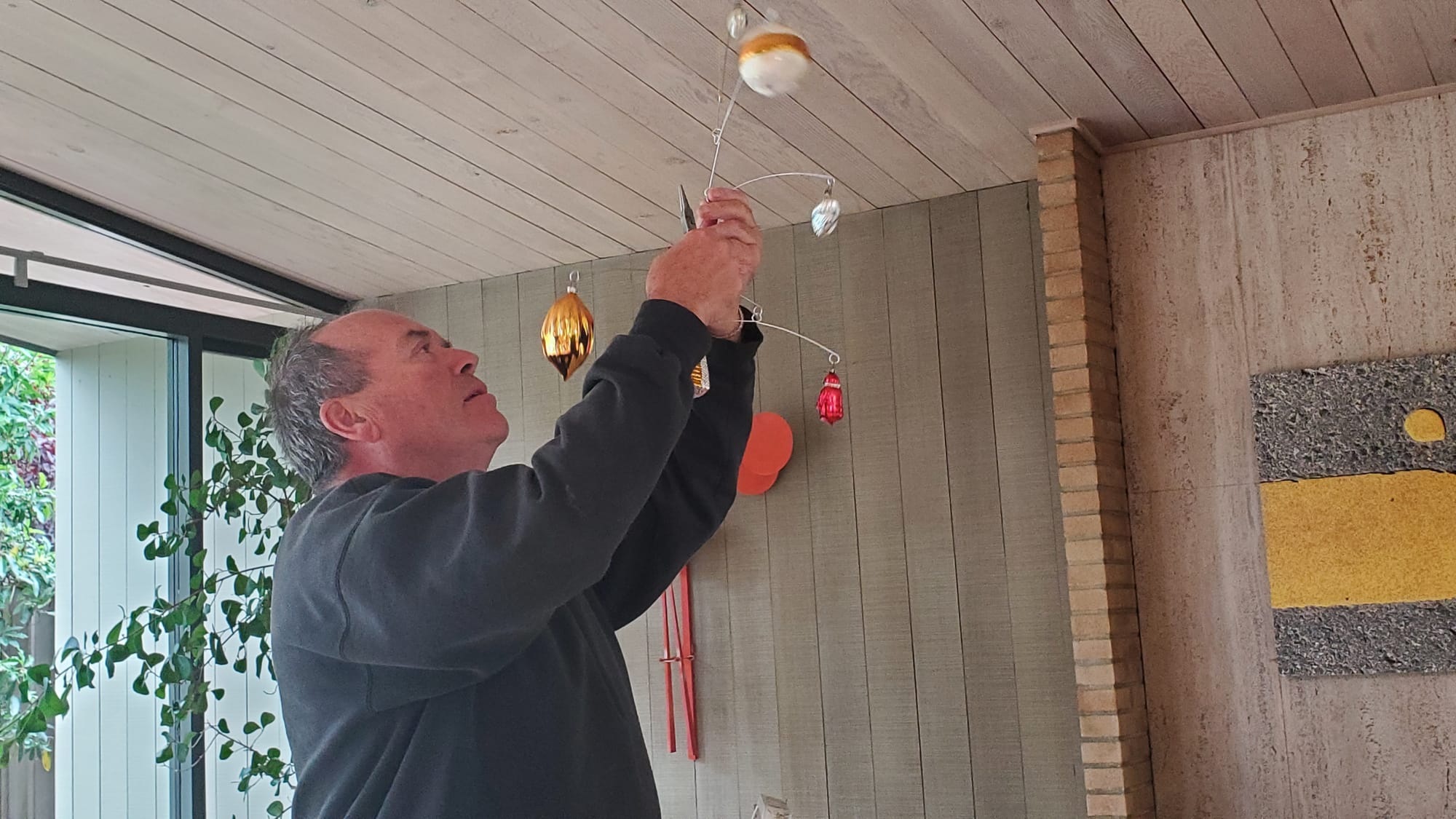
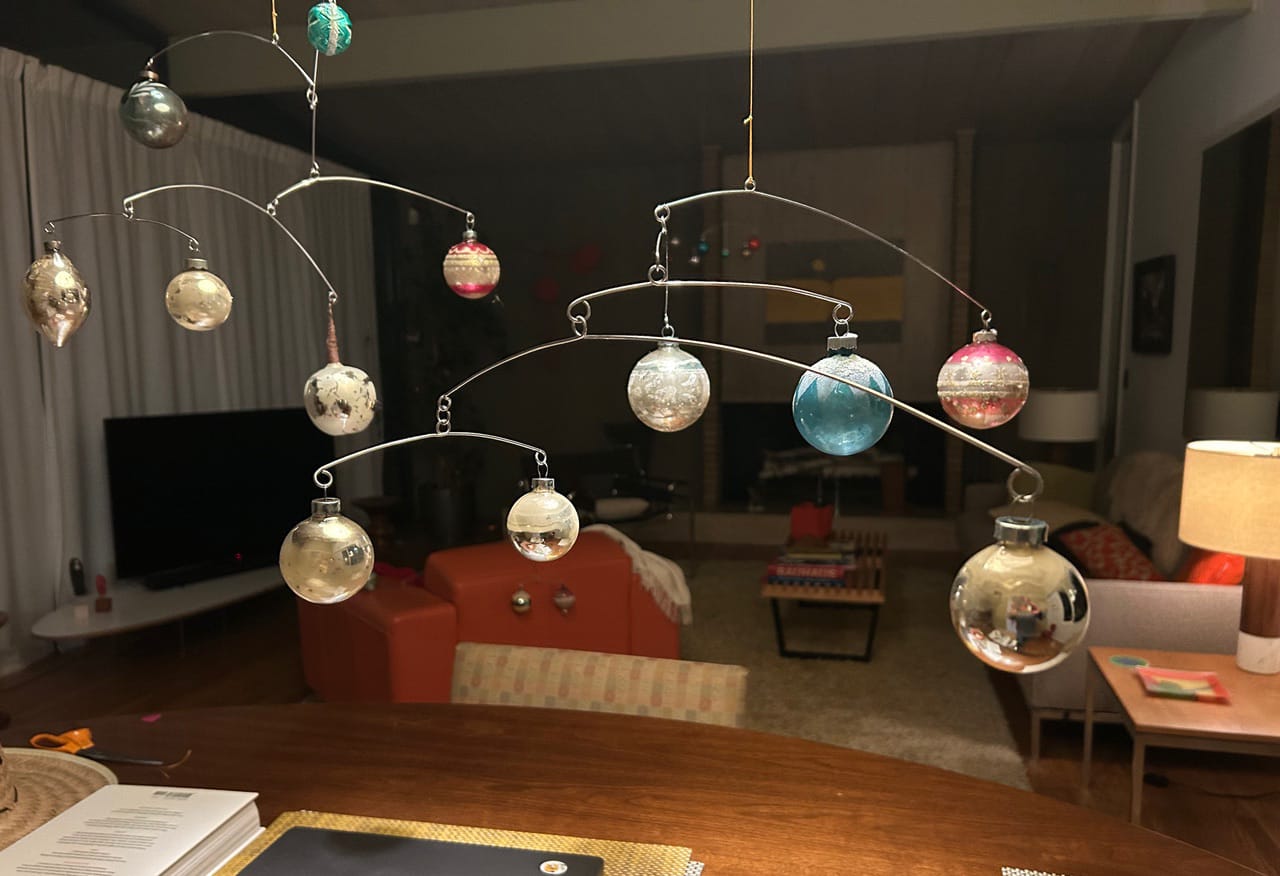
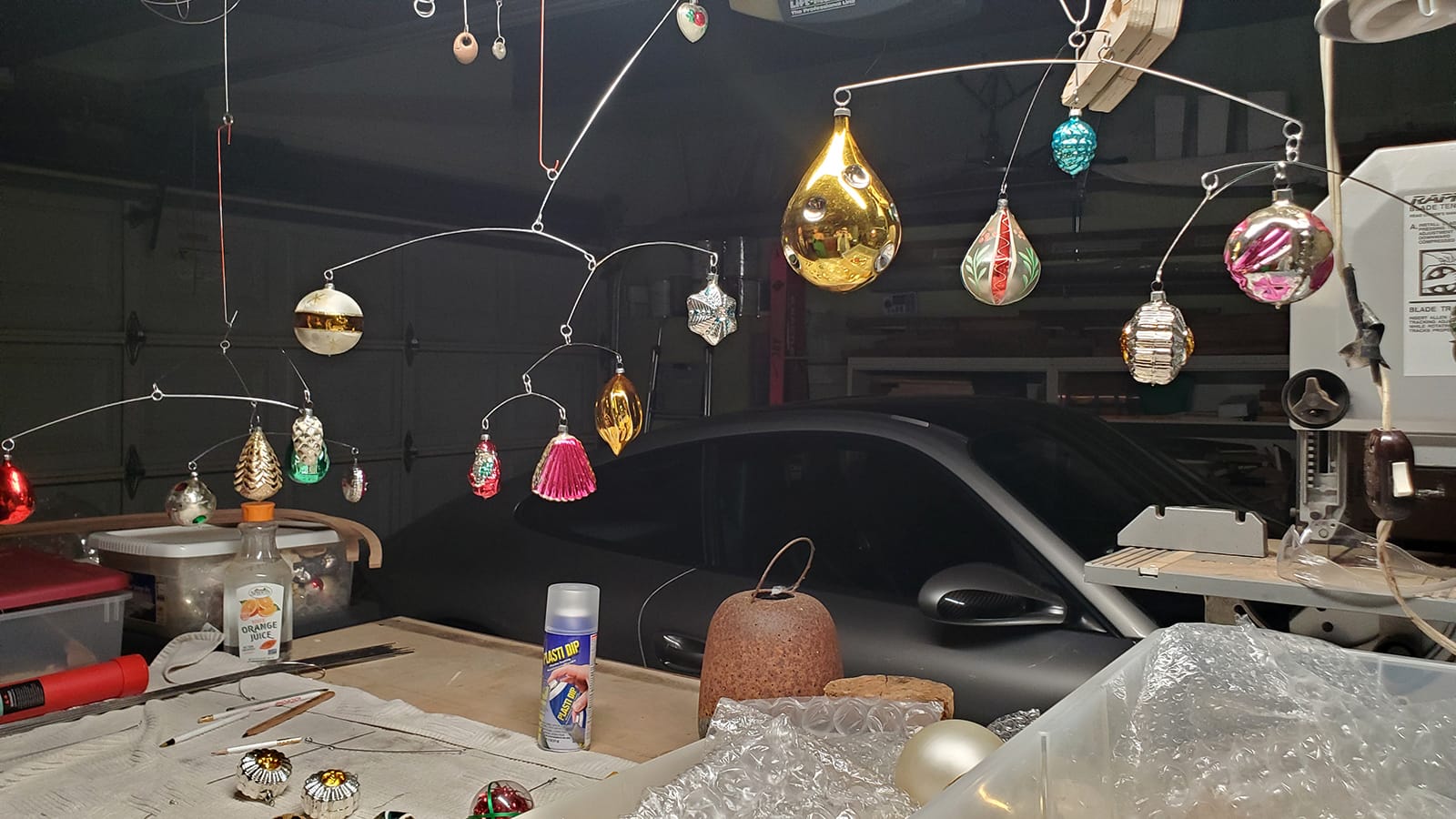
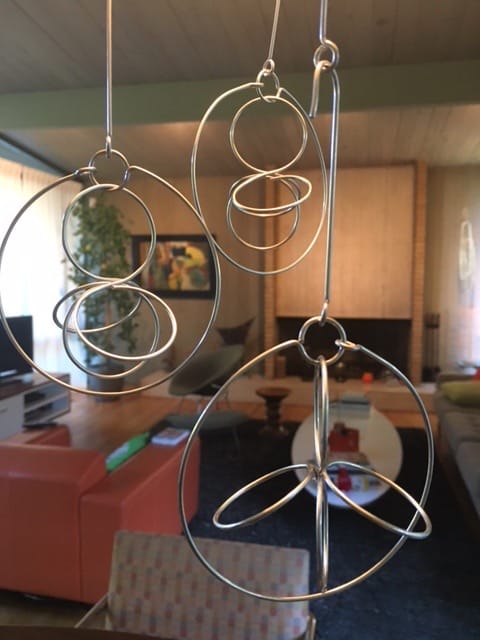
Tom makes his mobiles from antique Christmas ornaments. He also makes single peace symbol ornaments (shown above in the bottom row on right).
Tom now has enough vintage ornaments to create 60 to 70 mobiles. Because the thin glass pieces are so fragile, he plans to sell and deliver them locally, allowing him to repair any accidental damage himself and ensure each mobile is properly fit and balanced. All proceeds will be donated to the Alzheimer’s Foundation.
The cause is deeply personal. Tom lost his wife to Alzheimer’s last October, and hopes his mobile project can make a meaningful contribution to research. As a longtime donor, Tom says his contributions are matched through special giving incentives, multiplying the impact of every dollar raised.
“It’s very close to me, having lost my wife to it last October,” he says. “In the wake of draconian cuts to research, to the extent I’m able, I will step in and try to fill as much of that gap as I can.”
His next creative adventure is already taking shape. This August, he plans to travel to Maine to build a cedar canoe using traditional steam-bending techniques. Like so many of his pursuits, the experience promises to inspire new ideas—and perhaps the next chapter in his ever-evolving body of work.
To reach Tom, or learn more about his work, visit him at https://www.tomchantlerdesign.com/.


