



On October 20, 1991, Diablo winds fanned a wildfire through the Oakland–Berkeley hills, killing 25 people, injuring 150, and destroying 3,469 homes and apartment units. Oakland had faced one of California’s most destructive fire disasters.
Residents not only rebuilt homes and lives but also organized to help one another navigate insurance claims and recovery. United Policyholders, founded in 1991, became a national resource for insurance consumers and disaster survivors. Oakland, Berkeley and other local agencies formed the Hills Emergency Forum and strengthened their mutual aid, disaster management and standards for fighting urban wildfires.
Major fires have swept these hills repeatedly, including in 1923, 1970 and 1991. Dry vegetation and strong Diablo winds continue to create dangerous fire conditions. We cannot predict when the next firestorm will occur, but we can prepare now.
Thirty-five years later, it’s appropriate for us to remember, honor and prepare.
The Firestorm in a Nutshell
For those who did not experience the Firestorm, here are a few quick facts. The Oakland Firestorm was brought under control after three days, but today’s urban wildfires often burn for weeks. A study by UC Berkeley researchers applying the 1991 Firestorm conditions to the Berkeley Hills concluded that it would take at least two hours for everyone to evacuate. Oakland hill neighborhoods are very similar.
At its height, 1,500 firefighters and 450 engines from all over Northern California fought the Oakland Firestorm. By the time it burned out, it had consumed about 2.5 square miles, or 1,600 acres, of mostly residential neighborhoods. Twenty-five people were killed, including an Oakland police officer and an OFD battalion chief. One hundred fifty people were injured. The fire destroyed 3,469 homes and apartment units and 2,000 automobiles. Ten thousand people were evacuated.
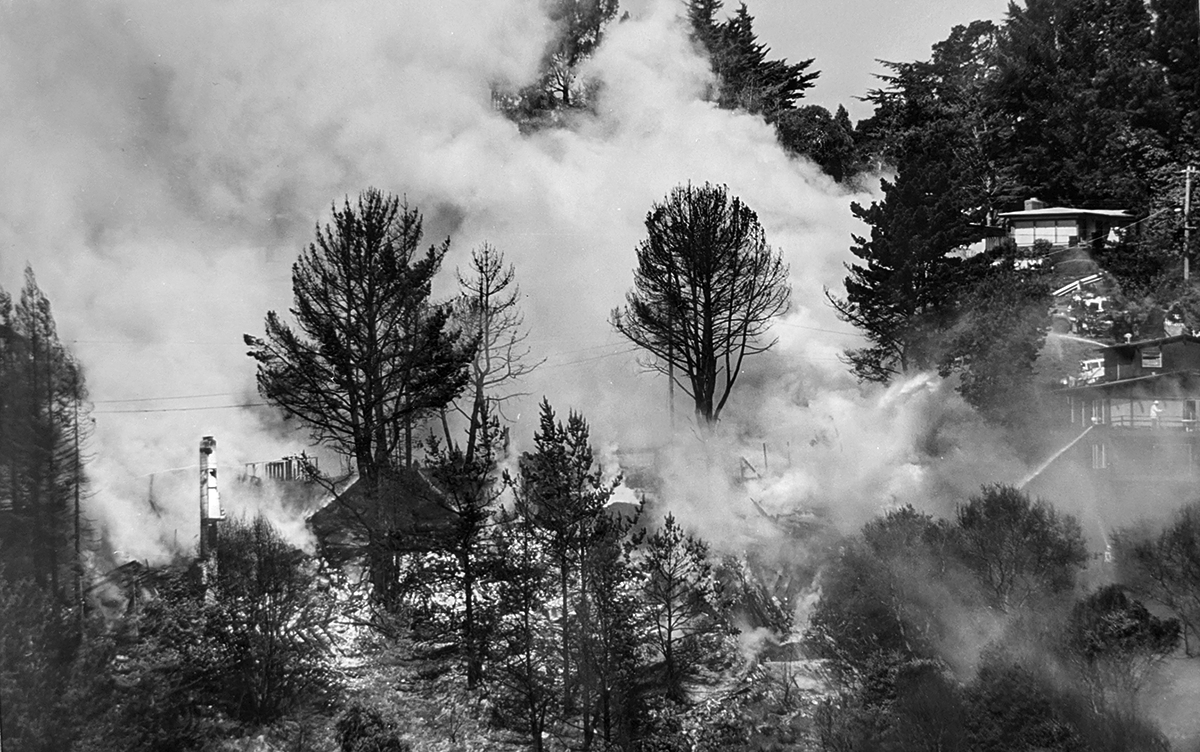

Rockridge, both hills and flats, has a number of quite narrow streets, often with only one lane in each direction, which can make orderly evacuation very difficult. People died trying to escape flames that moved so fast they barely had time to react. Narrow roads in and near Hiller Highlands, including Buckingham Boulevard and Charing Cross Road, became deadly evacuation bottlenecks. People were killed in their cars**, trapped by blocked roads and debris**. Others were overtaken by the fire after abandoning their cars and trying to escape on foot.
The winds were so intense and the area was so dry that within an hour**, nearly** 800 buildings were on fire. The wind pushed the fire southwest toward San Francisco Bay. In some places, the temperature reportedly reached 2,000 degrees Fahrenheit, making it virtually impossible to fight the fire effectively. Homeowners attempted to hose down their roofs but were often thwarted by failing water supplies. Also, many homes had wooden shingle roofs that were particularly susceptible to fire—it took only 10 minutes in some cases for a house to be brought down by the flames.
Lessons Learned
First and foremost, we must let go of the idea that this is a “hills problem” that does not affect those of us living in the flats. While the wildland-urban interface (WUI) areas of the Oakland–Berkeley hills and foothills are at particular risk, neighborhoods beyond those areas can also be threatened by wind-driven fire and embers.
Friends in OFD who worked the Firestorm have told me that, had the Diablo winds not died down, the fire could have continued toward West Oakland and the Bay. They described a great effort by multi-jurisdictional firefighting teams to keep the Claremont Hotel from catching fire. The back of the hotel did catch fire in a smaller firestorm in the fall of 1970. According to those firefighters, had the hotel caught fire in 1991, the next fallback fire line would have been Shattuck Avenue, potentially putting Rockridge and Temescal in the fire’s path.
Many people also falsely rely on the idea that “firebreaks” will keep a fire from spreading. Strong winds can carry burning embers across roads and other gaps in vegetation. It is difficult to imagine a larger and wider firebreak than Highway 24 below the Caldecott tunnels, but windblown burning debris crossed the freeway, from the northern side into upper Rockridge and Montclair on the south side. At the top of Birch Court, one block from College Avenue, burning eucalyptus debris landed in our garden and driveway for days. Ash from the fire also fell on San Francisco neighborhoods.
Home hardening offers ways to reduce a structure’s vulnerability to wildfire. There are firms that specialize in fire safety retrofitting. Yet, once an urban wildfire takes hold, firefighters may struggle to contain it. Recent disasters have shown how devastating these fires can be: whole towns and entire sections of cities have burned to the ground. After the 1991 firestorm, the few surviving houses stood like lonely sentinels dotting the blackened landscape here and there, few and far between, and their survival was usually a matter of sheer luck.
Take Precautions, and the Fire, Seriously
Make sure your home insurance is in order.
Have a regular review with your insurance agent. Be sure that your coverage reflects current rebuilding costs, including any coverage needed for building-code upgrades. Check what rebuilding your home on your lot would require, and review the dollar and time limits of your additional living expense coverage. It is very important that you upload copies of all insurance-related documents to secure cloud storage.
California’s wildfires have prompted insurers to reassess coverage in high-risk areas. In the aftermath of the ’91 Firestorm, many survivors discovered that they were woefully underinsured. Others faced difficult disputes over their claims. Ask your agent about your policy’s renewal status, watch for notices from your insurer, and discuss alternatives promptly if you receive a non-renewal notice.
First and foremost, take the risk seriously. During the Oakland Firestorm, some residents were reluctant to leave even as the flames approached. A fire that seems distant can quickly become an immediate threat. Never underestimate the speed and potential range of an urban wildfire.
Never forget that within the first hour, nearly 800 buildings were on fire. You cannot outrun that. Plan ahead, monitor official alerts and evacuation instructions, and leave early when conditions warrant.


