


What can you do to multiply monarch butterflies, enhance local flora, and learn more about your neighbors? Max Fancher has an answer: plant milkweed. “It’s easier than you think.” Max is raising monarch butterflies in his driveway on Boyd Avenue. He has carefully constructed a home where larvae can become caterpillars, caterpillars become chrysalides (plural of chrysalis), and, eventually, where brilliantly colored monarchs take flight.
“Basically, what I am doing is farming milkweed,” says Max, and he encourages everyone he meets to do the same. His “farm” is a graceful structure located adjacent to the sidewalk. A sturdy rolling table has openings for five-gallon buckets, a covered section with thin rails running horizontally, and two tall net cages that can be moved to cover the bucket openings.


Milkweed and verbena plants help maintain the delicate ecosystem needed for raising butterflies. Photos: Carol Kasparek
Five of the openings hold mature milkweed plants, with the fifth holding a tall verbena plant. An additional part of the ecosystem contains two rows of zinnias bordering the front lawn. The setup supports the life cycle of the monarch while drawing in anyone fortunate enough to walk by.
Buckets holding narrow-leaf milkweed from East Bay Nursery can be rotated for each stage of development. Eggs are laid on the leaves that Max nurtures by laying them on wet paper towels until the caterpillars begin forming.
The caterpillars are then transferred to a mature plant under a net, framed for protection. Paper wasps are a major predator of the caterpillars and the chrysalides they form, so nets are used to prevent them from entering the incubation chambers.


Buckets of milkweed are rotated for each stage of development. When the caterpillars begin forming, they are transferred to zinnias and other mature plants for food and protection. Photos: Anna L Marks
The chrysalides are beautiful objects on their own. The caterpillars curl into an azure cocoon, adorned with a ring of metallic gold dots. The dots are carotenoids believed to function both as oxygen ducts and to confuse and deter predators. A fine web connects the chrysalis and attaches it to the ceiling of the enclosure.
Until recently, Max individually moved and tied each chrysalis with dental floss to secure their transformation period. Now, to ensure protection from wasps, Max leaves them hanging for the remainder of the process.
As the transformation approaches the end of the life cycle, the chrysalis darkens to near black. When the butterfly finally emerges, it stays attached by its long, delicate legs to what now appears to be translucent tissue.


The enclosures reveal the many phases of metamorphosis of the Monarch butterfly. Photos: Anna L Marks
Newly emerged butterflies have huge abdomens and tiny wings. Within minutes, the blood from their abdomens flows into their wings, creating the slim-bodied, expansive-winged butterflies that flutter around us. At this stage, Max moves most of them to the final enclosed area, where the purple flowers of the verbena plant help introduce them to their new environment.
After a day of growing stronger, Max opens the net and releases them to their Rockridge neighborhood. Brilliantly colored zinnias at the edge of the driveway provide a convenient source of pollen for their first meal.
Video clip: Max Fanchur
The journey to raising monarchs began early for Max.
“I grew up in Santa Cruz. My mom always brought us to Natural Bridges to see the butterflies. As a kid, it was magical. The butterflies seemed to drip from the eucalyptus and filled the sky.”
Decades later, the environment had changed. “When I took my own kids to the park, the numbers were very small. We had to really look to see the butterflies.” Max did not want to accept the disappearance of these beautiful residents.
“I was inspired to do something about the situation by a woman at the Monarch Inn in Santa Cruz. I watched how she set up the environment for monarchs … so genius.”
Max also took a weekend class with the Pollinator Posse where he learned about raising healthy plants, and the details of butterfly development. As he shared his monarch tutorial for this article, several folks walked by and joined in the admiration of the “milkweed farm.”
“People are out here all the time,” noted one woman returning from shopping on the avenue. Another peered closely at the middle chamber, commenting on the progression of the incubation. “She works at Market Hall, comes by almost every day on her way to work,” explains Max.
Two other self-identified visitors locked onto the structure, reading the information Max had posted and expressing amazement at being able to see the transformation in progress.
“When you move somewhere, you usually don’t know anything about your neighbors. We lucked out,” Max declares.


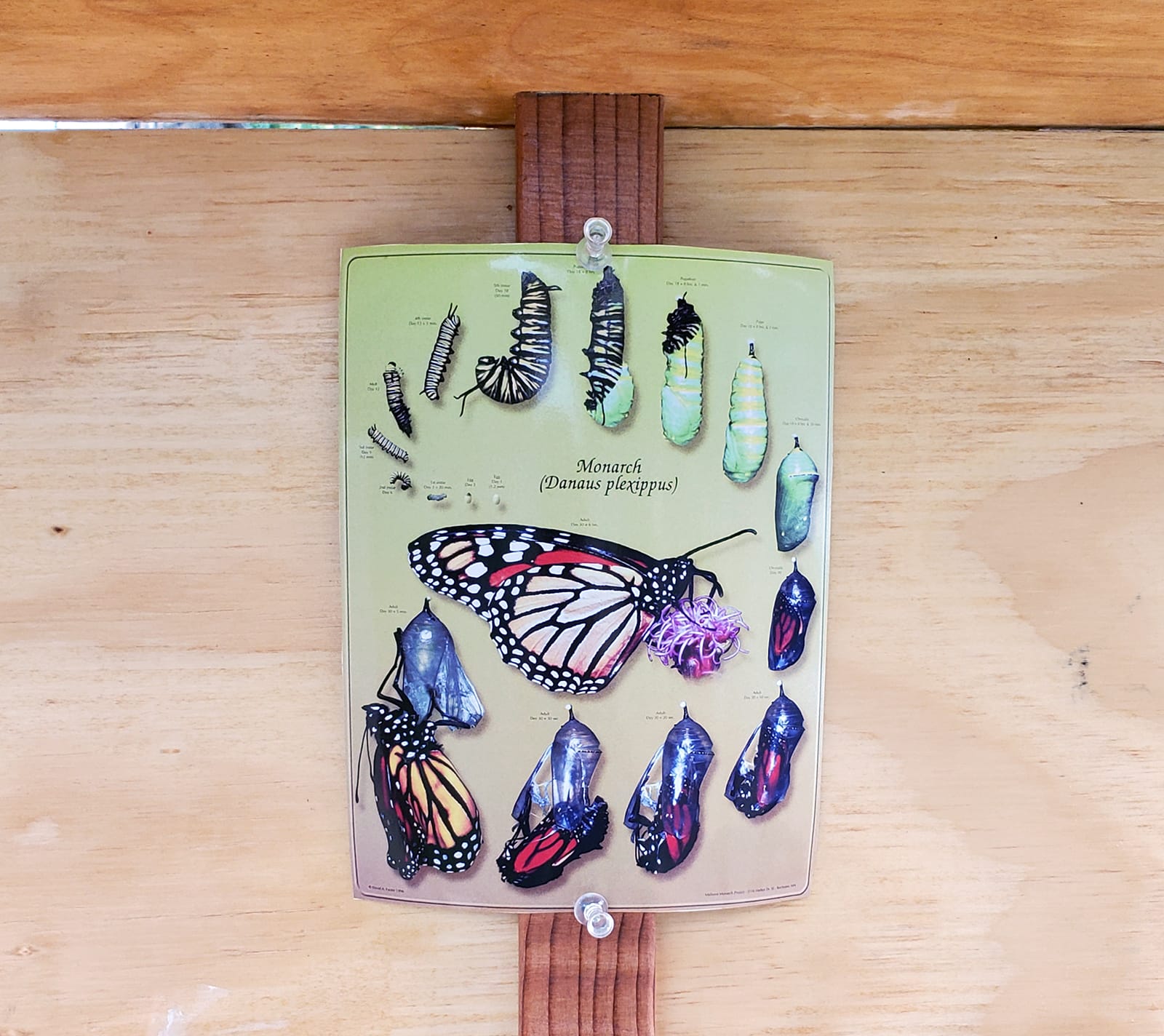
Signage helps educate visitors about the life cycle of the monarch. Photo: Anna L Marks
Max’s family moved from Montclair to Rockridge 14 years ago for the walkability, the sidewalks, proximity to schools, and Chabot Elementary. He recalls, “it was not great trying to push a stroller down Snake Road.”
Now, his challenge is making sure the monarchs are safely monitored, and releases them when they are ready. He examines the chambers several times each day.
“I dork out about it,” admits Max. “So many people come to check it out. I’m suddenly introduced to folks who live just a block away. That part is the coolest.”


