

The recent proposals to build high-rise (often defined as 12 or more stories) and mid-rise (5–12 stories) buildings in lower Rockridge bring to mind an argument from nearly 60 years ago when construction of Highway 24 and the BART line, including the Rockridge Station, forced the removal of 1,400 homes and essentially shut down College Avenue.
Originally, the freeway was planned to go up Ashby Avenue (which is still a designated part of the State highway system, now numbered CA-13). Berkeley’s residents were well-organized, and pushed back on those early plans — pushing the freeway relocation to the working-class neighborhoods of North Oakland, Temescal, and West Oakland flatlands.
Many businesses closed, and the future looked dim. Downtown Oakland development interests proposed tearing down buildings on or near College Avenue and replacing them with mid-rise office and apartment buildings. Under the proposed zoning change, Rockridge would become a secondary business center for Oakland.
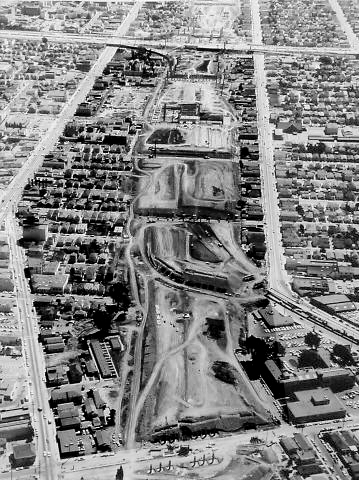
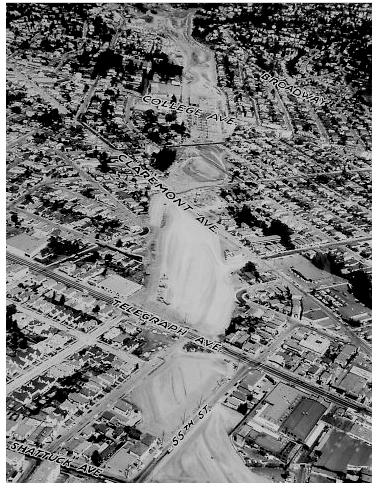
These 1967 aerial photos show the excavation for the Grove-Shafter freeway and the huge swath of land it laid bare in the Rockridge neighborhood. Russ Reed, untitled, 1967. Gelatin silver print, 14 x 11 inches. The Oakland Tribune Collection. the Oakland Museum of California, gift of ANG Newspapers. ©The Oakland Museum of California
Rockridge residents and store owners united to oppose the change. They noted that Rockridge brought more retail revenue into Oakland than any other part of the City, including downtown. They also pointed to the area’s walkability, its urban village atmosphere, and its pleasant mixture of single-family and small multi-family buildings, many dating back to the era following the 1906 San Francisco earthquake — all of which made Rockridge a desirable area.
People in Rockridge got together and formed the Rockridge Community Planning Council. A group of RCPC’s members created new zoning categories for commercial and residential areas designed to preserve and enhance Rockridge’s existing character. Under community pressure, the City Council adopted the new zoning. Since then, it has proved remarkably successful.
Now, however, the situation may have changed. The Legislature, under pressure to produce more housing, and particularly affordable housing, has cranked out a stream of new laws requiring all cities to produce more housing. Other new laws mandate higher housing densities, overriding local general plan and zoning standards. The state’s Department of Housing and Community Development (HCD) and Attorney General have been “deputized” by the Legislature to enforce these new laws.
In Oakland’s case, HCD overrode local community input and pressured the City to adopt higher densities in its general plan and zoning. In Rockridge, much of College Avenue was rezoned to allow five-story buildings by right, and much higher buildings could be built without requiring City approval if certain state-mandated “density bonus” laws applied.
Despite all that, no high-rise bonanza has followed. Why? The reason is economics. As a highly popular and successful area, land values for Rockridge, both residential and commercial, have skyrocketed. It turns out that the most profitable option for a landowner is usually to leave things as they are.
Nevertheless, developers continue to put forward unrealistic proposals because land with an approved development plan becomes more valuable. With the new State laws (thank you, Buffy Wicks and Nancy Skinner), it’s gotten harder and harder for the City to say no, even if what’s proposed makes little sense. Recent examples of such fantasy projects have been the abortive Shops at the Ridge retail proposal and the California College of the Arts (CCA) site mixed-use redevelopment project. Both were approved; neither will be built.
The latest proposal, to replace the thriving Trader Joe’s store almost adjacent to the Rockridge BART Station with two high-rise towers (one 25 stories, the other 31 stories) containing 415 market-rate senior housing units, is likely to be another “no-go” project.
Preliminary plans show three stories of parking, a fourth-floor “amenity” floor, then one story of “memory units” (i.e., dementia care), one story of “assisted living” (i.e., disabled residents), and the remainder generalized senior living apartments.
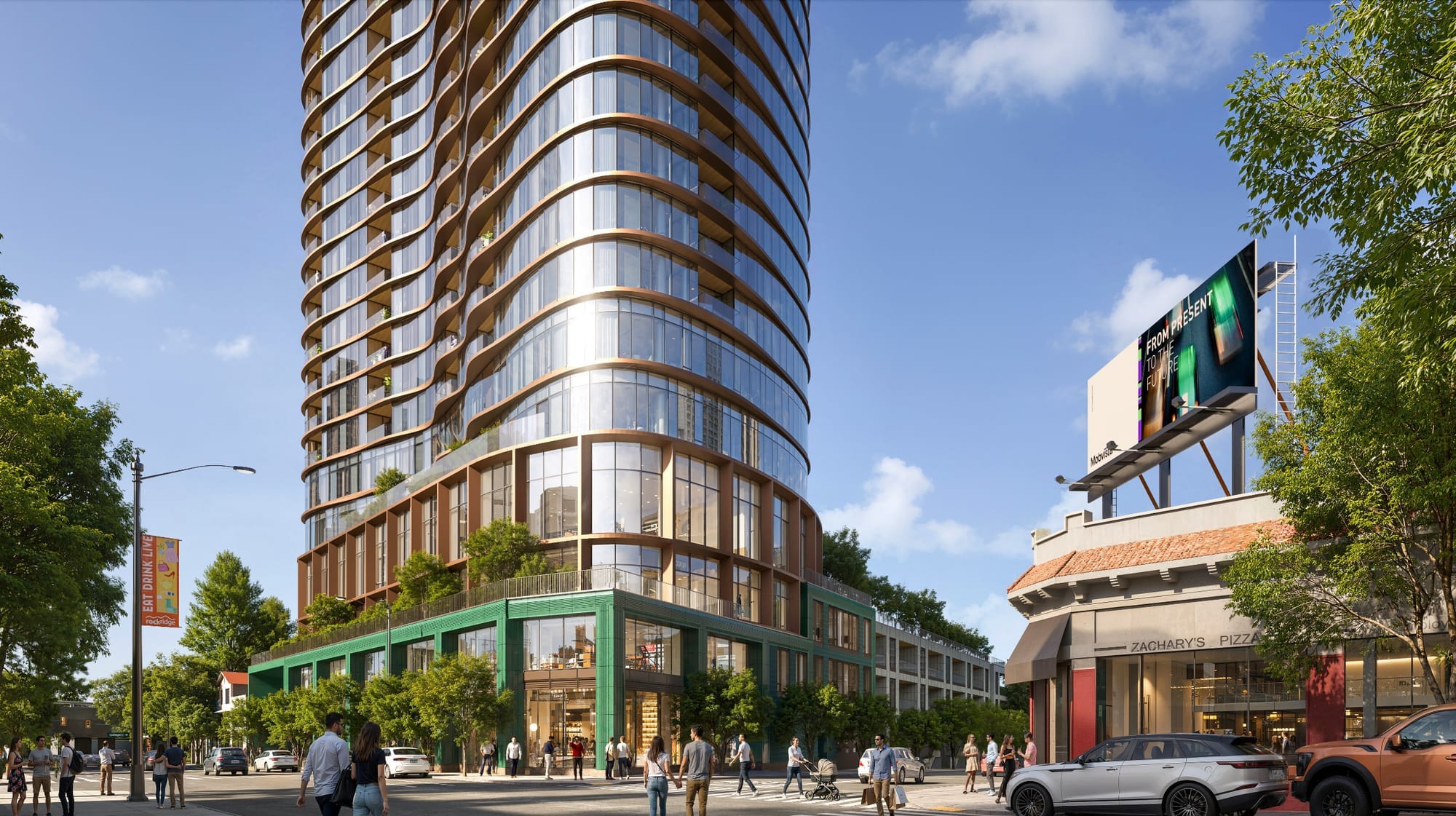
What are the problems? To begin with, the site is directly adjacent to the underground culverted Temescal Creek, which flows southward towards Lake Merritt and the San Francisco Bay. Associated with the creek are groundwater flows under the site, making it difficult to build tall buildings.
The alluvial soils underlying the site would be subject to liquefaction during any significant earthquake. The entire geographical area is projected to experience an earthquake of magnitude 7.2 within the next 20 years.
To design two high-rise buildings on such a site to survive an earthquake of this magnitude without significant damage would be a major engineering challenge. Even if the buildings survived unharmed, utility services would almost certainly be interrupted for weeks, if not months.
Further, with the two buildings being entirely occupied by elderly tenants, some major injuries could be expected, especially on upper stories, where shaking would be more extreme. Elevators would be rendered inoperative, pending inspection and possible repairs, meaning evacuation of those injured would need to be done manually by carrying residents down to the ground floor.
Even if they reached the ground floor successfully, roadways (and the adjacent freeway) can be expected to have major damage, making them impassable for an extended period. Although a city fire station is located within a few blocks, fire personnel would likely be greatly overtaxed, offering only limited EMT-level medical services. Unless the building proposes to include very significant self-contained medical facilities, with 24-hour medical staffing, one can predict major casualties. (No such facilities are shown on the preliminary plans.)
In short, while the new state laws greatly limit the city’s ability to reject a project, it can be turned down if it would cause a specific adverse impact on public health or safety that cannot feasibly be mitigated. The previously described effects would appear to be such an impact.
For a local viewpoint about the YIMBY organization, see the Defend California video:
Empty sidewalks. Big hole in the ground
(Creative Commons License. Uploaded on Feb 24, 2026)


