


Talk about community…
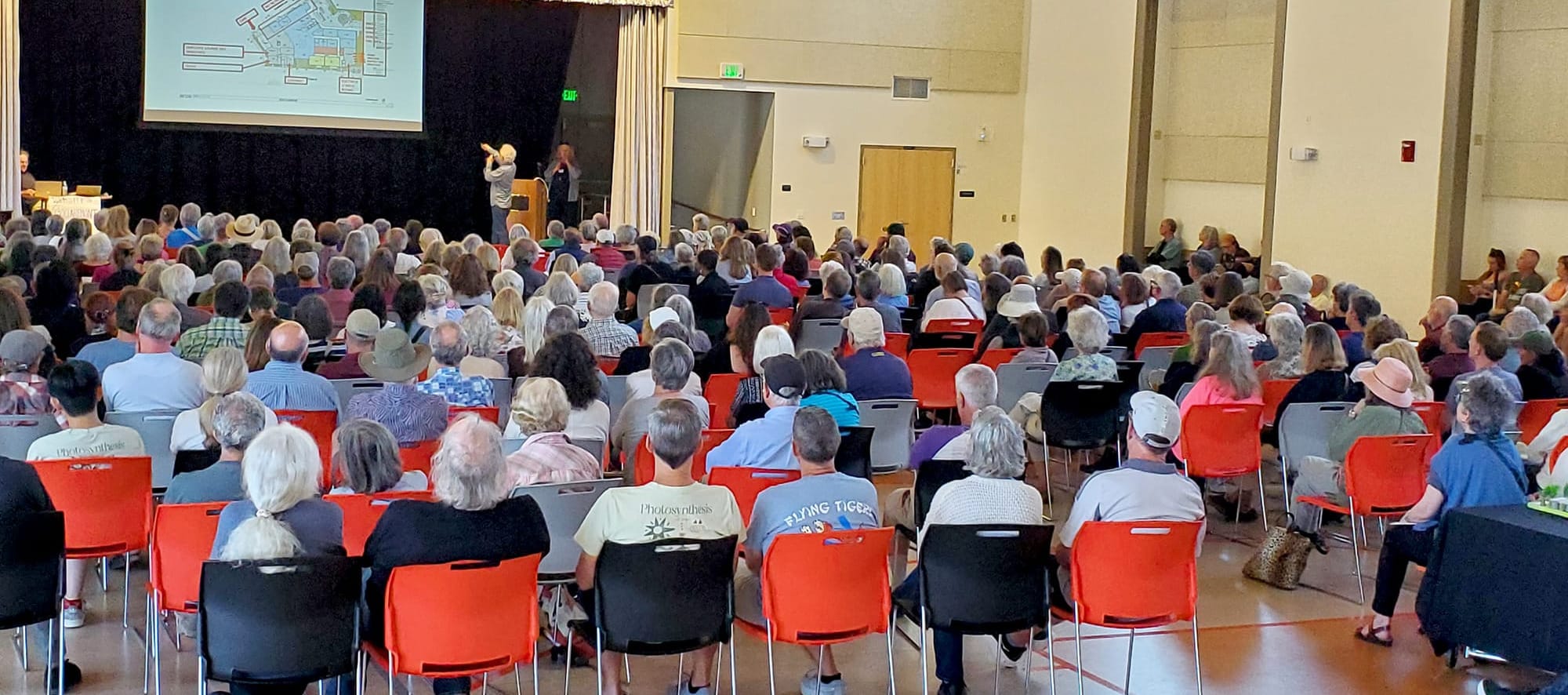
More and more chairs had to be added to the auditorium at Claremont Middle School when approximately 300 neighbors came together last Saturday to hear facts and figures regarding the two proposed senior housing developments, raising a ruckus in Rockridge.
If you haven’t heard, one is an eight-story, 203-unit facility planned for the former Red Cross site on Claremont Avenue. The other, twin towers rising to 25 and 31 stories, housing 415 living units, an auditorium, restaurant, pool — and displacing the Trader Joe’s grocery store. Both projects are targeting seniors who can afford to pay market rates.
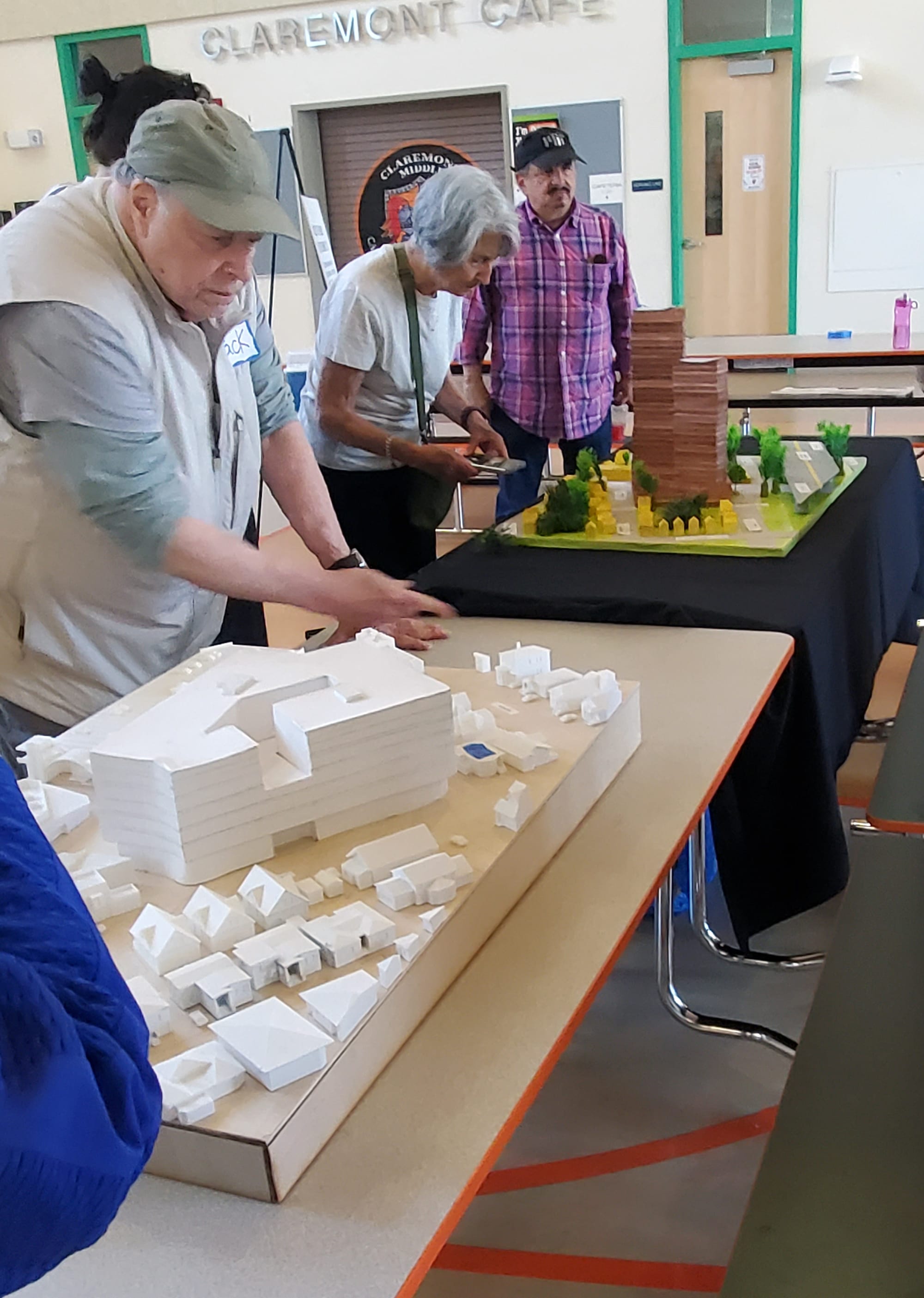
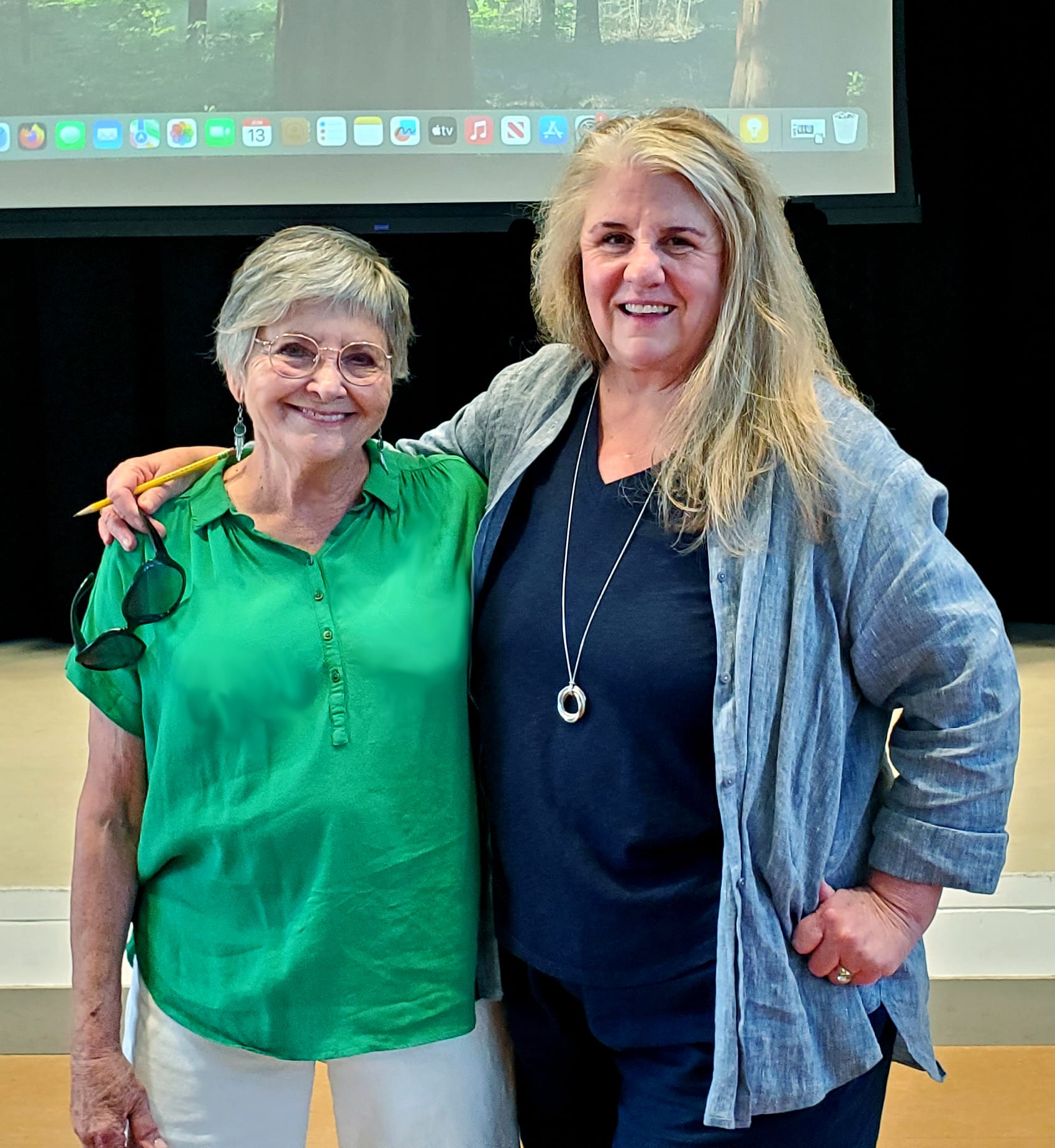
Left: Models of each project highlighted the size in relation to the nearby surroundings. Photo on right: Myrna Walton of Upper Broadway Advocates and Leila Gough of Rockridge Neighbors for Sensible Housing organized the educational forum for the community. Photos: Anna L Marks
“What I’m hoping is that we get our neighbors educated to understand the housing laws coming down from the state,” said Leila Gough, who organized Rockridge Neighbors for Sensible Housing (RNSH) to protest the scale of the Claremont site (their online petition has garnered nearly 2,000 signatures since December, 2025).
They teamed up with Upper Broadway Advocates (UBA), begun in 2019, to hold Saturday’s forum. Both organizations support needed housing, but reject outsized developments that disrupt the scale of the neighborhood, set market rates, and offer no subsidized units.
An attentive audience heard two of their neighbors make presentations. Jack Gerson, who holds a doctorate in biostatistics, and Javier Arizmendi, an award-winning architect, laid out what the community is up against.
According to Gerson, three state laws intend to make it more difficult for local governments to deny or delay builder’s applications.
“Having the State acting as enforcer provides them an easier path to approval. Whether this has actually worked is debatable, but what is very clear is that input from local governments and residents have been greatly reduced,” said Gerson.
These laws include:
1) The State Density Bonus Law, under which senior housing developments, including Residential Senior Care Facilities, are entitled to a 20% density bonus (with no requirement to including affordable housing);
2) The Housing Accountability Act (HAA), which severely limits the grounds on which local governments can deny or regulate applications for new construction; and
3) SB330, which is, in effect, the enforcer of the Housing Accountability Act—closing loopholes and stiffening penalties on local governments that don't comply with HAA.
Despite these legal changes, the presenters offered a glimmer of hope if Rockridge can prove how each proposed development undermines the neighborhood’s health and safety. Gerson and Arizmendi both noted that the 6230 Claremont developers have proposed building more units than they are entitled to, and Arizmendi explained why in some detail.
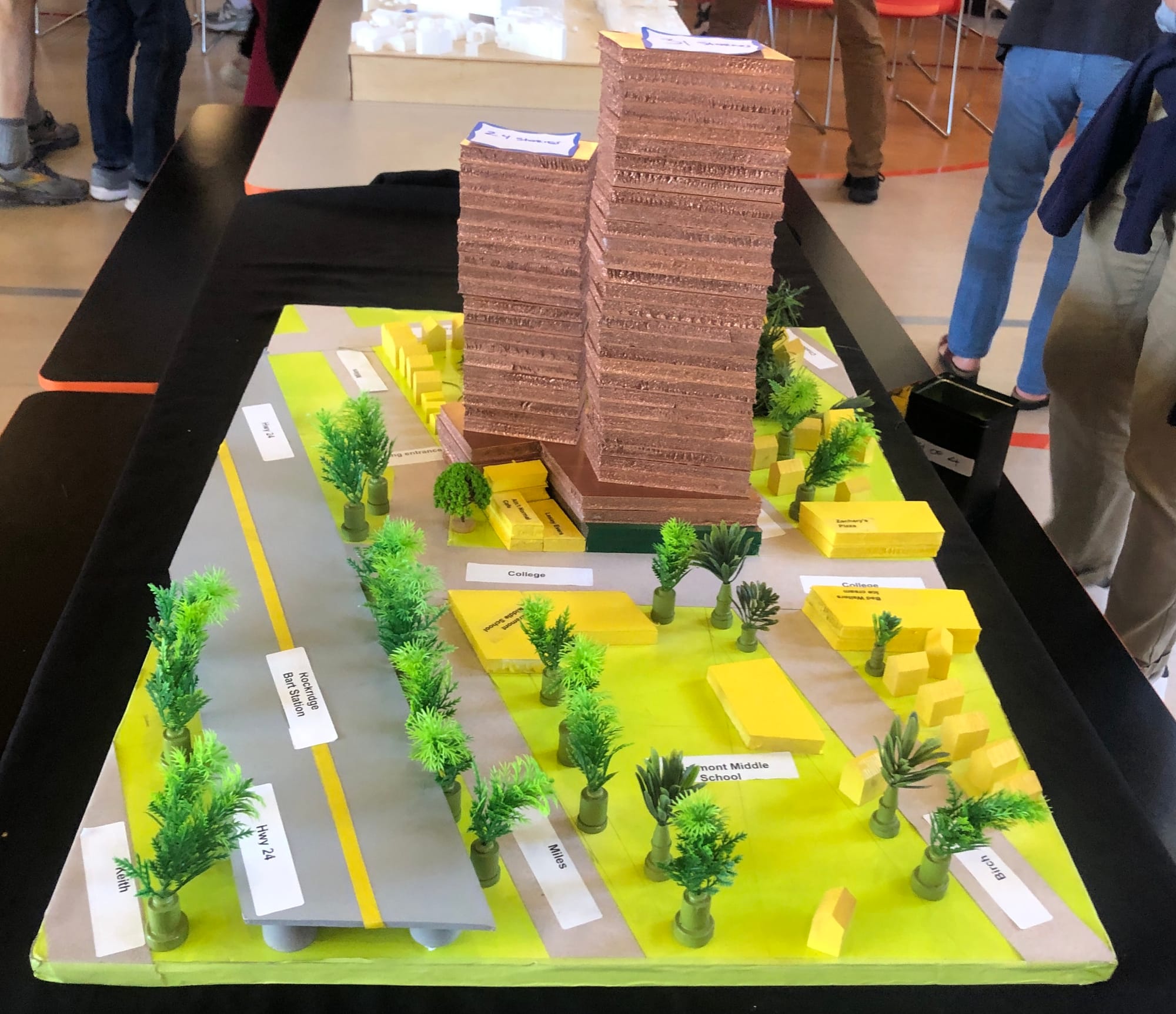
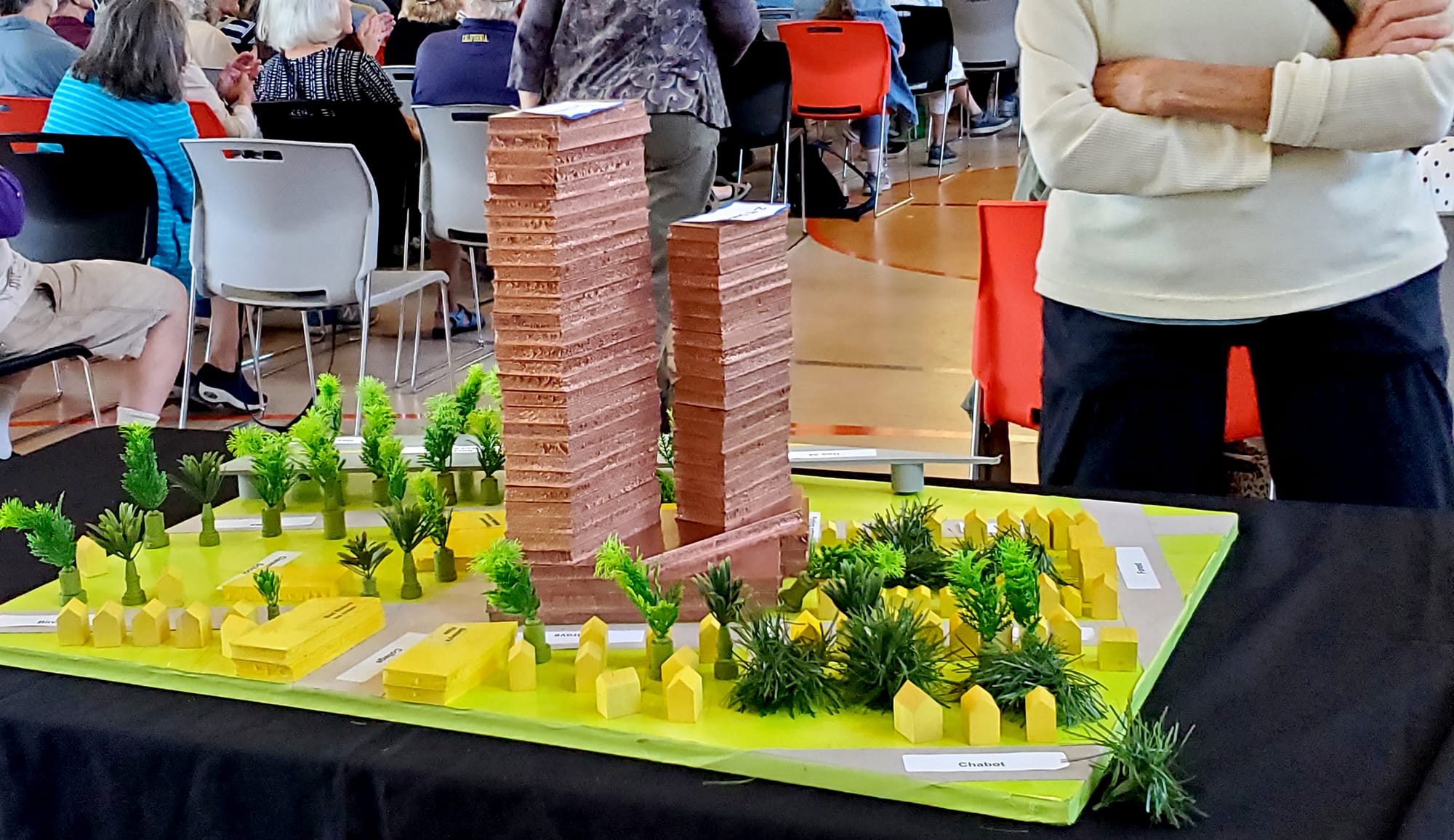
Local artist and urban planner James Rojas created a color-coded model of the proposed two towers at Trader Joe’s. Copper represents the new development while yellow represents the existing homes and businesses. The goal is to help people understand the scale, presence, and potential impact of the proposed development within the existing community. Left photo: James Rojas / right photo: Anna L Marks
California’s housing laws weigh heavily on the developer’s side, no matter how a project fits in with the neighborhood, Gerson’s study confirmed. To build senior housing, “they don’t have to provide affordable anything,” Arizmendi said. “We recognize a housing shortage, but these developers have a more ambitious agenda.”
A city or town is a system of systems, Arizmendi explained, including traffic, property values, privacy, green space, light, and ventilation. He diagrammed how the Claremont project would block sunshine from neighboring homes and businesses including the Safeway Plaza, a gathering place for coffee and conversation.
As further examples, he showed how the developer’s placement of the structure’s mechanical room would create constant noise for the adjacent homeowners, and that the proposed garbage pickup location would adversely impact the surrounding neighbors.
Myrna Walton, a member of UBA, explained that although Arizmendi concentrated on the former Red Cross site, “much of what he said applies to the two terrible towers.”
“We do know that community support counts,” Walton said, and encouraged community leaders, such as Oakland City Councilman Zac Unger, who was in the audience along with at least two board members of the RCPC (Rockridge Community Planning Council), “to support us, work for us, represent us. Working together can accomplish so much more.”
“We don’t know when the clock will be ticking on this project,” Walton noted, but promised to keep everyone informed. In answer to an audience member who asked, “What are real concrete things we can do?”
She encouraged people to sign up to write protest letters to the City Planning Commission and Oakland’s planning department, and to picket both Safeway stores in Rockridge, and the Red Cross on College.
“It’s such an insult that Sacramento can override what neighborhoods want,” said Christine O’Connor, a 55-year Rockridge resident who attended the meeting.
Her view seemed to represent those of the majority of people in attendance. She also expressed disappointment that “The RCPC is not very involved at this moment.”
During a short question and answer period, an audience member brought up traffic concerns the towers would pose for students attending Claremont Middle School, located just across the street. Others seemed more upset about losing a beloved food store.
“My opinion is not the majority,” Brandon Adams said, while waiting for the session to begin. “As a pro-housing advocate, I’m less offended by height than width,” such as when a building takes over an entire block. “But I’m devastated about losing the Trader Joe’s.”
Another attendee suggested building denser housing, but on a more human scale. And yet another concluded: “I want to thank you guys for putting on a real educational forum.”


