


Establishing a Historically Black College or University (HBCU) in Oakland has been talked about for decades. But Kim Thompson and fellow members of her “Dream Team” — Dr. Kimberly Mayfield, EdD, Dean of Saint Mary’s College of California’s School of Education, and Taina Knox, director of Ceiba Strategies — are working to make that long-held vision a reality.

Congress officially created the legal designation and definition for HBCUs under Title III of the Higher Education Act of 1965. More than a hundred accredited HBCUs educate 20% of all Black college graduates and 25% of Black STEM graduates in the United States. But incredibly, none are west of Texas.
“California has the fifth largest Black population in the country,” Thompson said, “and Oakland has been the center of Black culture” — a culture shaped by strong Black leadership, educators, entrepreneurs, artists, musicians, and filmmakers.
An HBCU would add to the Bay Area’s mix of higher educational opportunities, she said, including UC Berkeley, Northeastern at Mills College, and the new San Francisco extension of Vanderbilt University.
What could be a more natural step for Thompson, who after a long career rising to partner at PricewaterhouseCoopers, and then as a full-time founding fellow to the CEO Action for Racial Equity program, than to continue “helping Brown and Black people” in retirement.
Thompson, a long-time Rockridge resident, along with her husband John Bliss, has been on the front lines of Oakland philanthropy, donating both time and money to various initiatives focused on the underserved Black and Brown community and youth development. For years, they’ve opened their spacious 1936 Tudor Revival house in Rockridge, awarded Oakland Historic Status in 2013, for monthly community events to benefit various Oakland-based organizations.
Thompson chairs the MLK Freedom Center, is on the executive committee of Oakland Promise, and serves on the boards of Legal Services for Children, the Cowell Foundation, and the Oakland Roots men’s soccer team.
“I’m fortunate to work alongside Kim on this effort and I know advocacy is what will move this project over the finish line,” Knox said. “Her spirit is contagious and her passion for Oakland shines through in all she does. She loves this city and works tirelessly to make it a place where others, particularly young people, have reason to celebrate.”
“She’s like the Energizer Bunny,” Mayfield said, “with time and energy to devote to the initiative.” Her ability to engage and assess when an HBCU’s interest is more aspirational than practical has been so helpful. And “she’s been able to provide her home as a meeting venue.”
It was Mayfield who restarted the HBCU ball rolling in Oakland when she was deputy mayor from February 2023 to December 2024, Thompson said. “She asked if I would co-lead the effort. It felt like a natural thing to say ‘yes’ to. The three of us have both overlapping and a range of skill sets. We make a good team.”
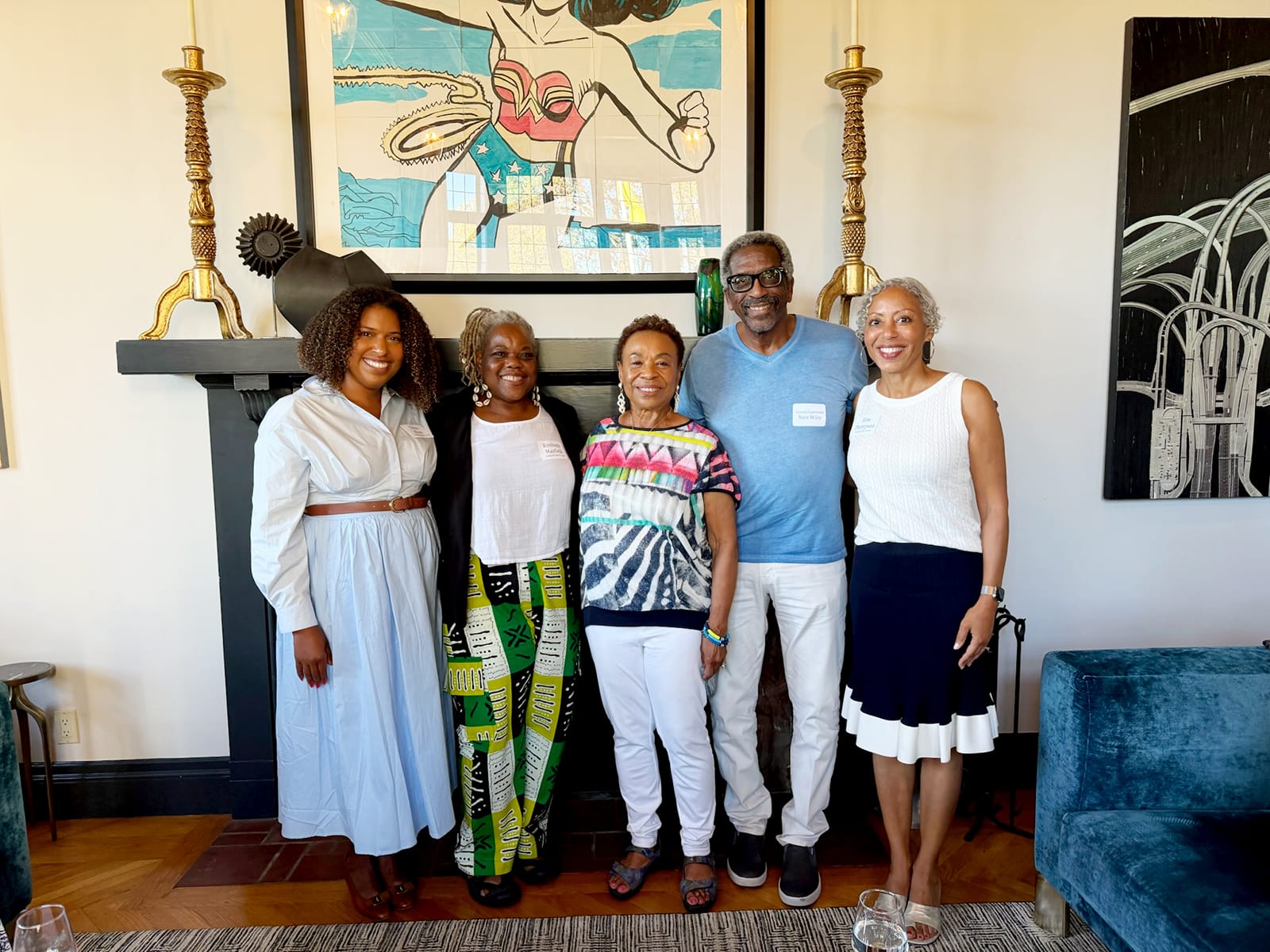
They’ve already raised $300,000 for a planning and feasibility study, including a grant from Alameda County, that is well underway. Results, due in early fall, will focus on “what would make sense from an Oakland perspective,” she said. “We have support from every direction,” Thompson said, with a task force that includes community leaders, educators, philanthropists, federal, state, and city officials as well as representatives from business, tech, and real estate. “Mayor Barbara Lee is a very big part of it.”
That it won’t be a start-from-scratch college or university is a given. The hope is that an existing HBCU or coalition of HBCUs would create an Oakland branch.
“We’ve been in touch with several of the major Black colleges,” Thompson said. “It’s been a three-step forward, two-steps back kind of thing.”
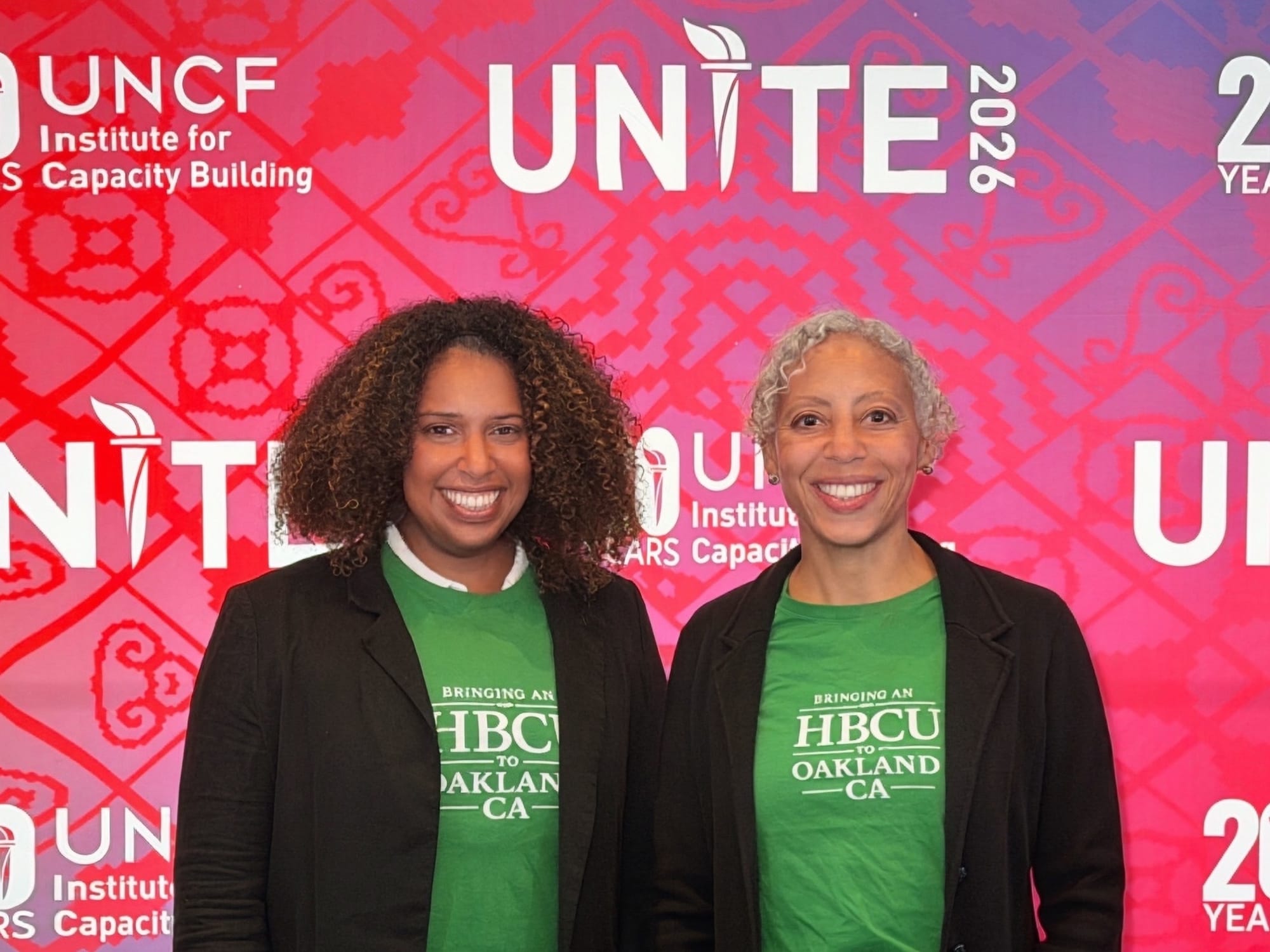
Last week, Thompson and Knox presented their proposal to the 20th Annual Unite Conference of the United Negro College Fund in Atlanta. “Our presentation went really well,” Thompson said. “We had in-depth, individualized conversations with a few different schools and got some very positive feedback. We also have calls with several other schools’ leaders over the next couple of weeks.”
It would be up to any HBCU that decides to expand to Oakland to determine its structure, curriculum, and location, she said. But a possible scenario would continue to utilize community colleges to educate freshmen and sophomores, who might then go on to their junior and senior years at an Oakland HBCU. “The Peralta [Community College] system has a higher percentage of Black students than anywhere in California,” she said.
The California Cal-HBCU Transfer Grant Program gives a stipend of up to $5,000 to community college students who complete their transfer pathways to attend a participating HBCU. “An Oakland HBCU could keep and draw folks here,” Thompson said, because, when all the Black colleges are in the East, “graduates tend to stay on the East Coast.”
A pilot program with a curriculum that focuses on Oakland’s strengths could offer majors in biotech, AI, entrepreneurship, and climate technology, she said. Thompson would love to see it located in the heart of Oakland but notes that the now closed Holy Names University is also a possible site. “We’re going to follow what the institutions want. We’re interested in the what, rather than the where.”
A bonus is, “We have Goldilocks weather, neither too hot nor too cold,” she said. “Oakland is the perfect place for an HBCU to exist.”
To learn more about the Oakland HBCU Initiative and how you can help, go to the oaklandfund.org/oaklandhbcu website.


