


For a third time in two months, Rockridge residents gathered to address concerns about the two luxury senior housing projects, one with two huge towers, that are being proposed for the neighborhood. The July 13th Town Hall meeting was called by District 1 Councilmember Zac Unger in an effort to explain why community input has been intentionally sidelined as a result of recent State housing laws.
“A big part of those State laws has been to take rooms like this out of the picture, and to take elected officials like me out of the picture,” said Unger.
Unger stated that, despite the fact that Oakland has been doing a great job of building affordable housing, our legislators in Sacramento have written a series of laws that intend to speed up projects with higher density and fewer regulations, and that suspend environmental impact reports.
Planning Department staff were also on hand to answer questions, and explained how AB 130 allows a CEQA exemption on “infill-housing.” The TJ’s site is the first project in Oakland to use the new law, which has a very short checklist of environmental requirements that they must meet to be exempt.
Despite current successes in expanding affordable housing in Oakland, new, high-end projects are being pushed forward by the new State Density Bonus Laws, along with waivers, that make them harder to challenge by those who would be directly impacted.
“Oakland has been doing an amazing job building affordable housing. We are far ahead of our peer cities around us. We built 700 units of affordable housing last year. We have about 2,500 units of affordable housing in the pipeline for the next two years. That’s ahead of our goals.” said Unger.
Neither of the Rockridge projects include any affordable units, but because of the loophole, senior housing can use all of the bonuses available to bypass current zoning and build huge construction projects regardless of the current residential surroundings—an unprecedented move from the top down.
“State Housing and Community Development Department was hyper-focused on wanting to see development in the Rockridge area,” said Planning Department staff.
Unger went on to explain that if cities prohibit qualifying projects, they could be penalized up to $50,00 per unit, and if the TJ’s project is blocked without merit, it would result in a $20M fee to the City.
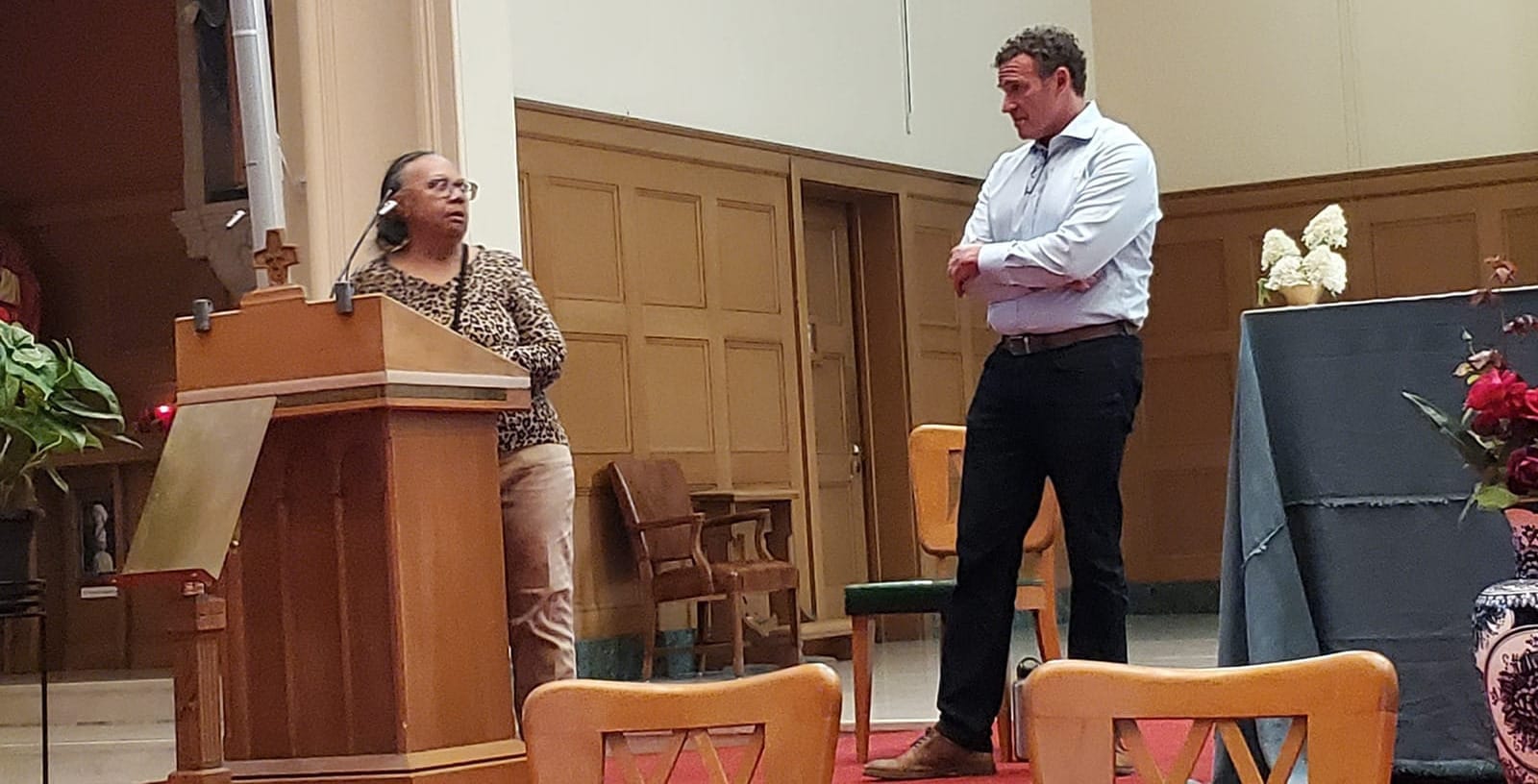
Audience members suggested a recall of Wicks, a boycott of Safeway, and encouraged the signing of two petitions (Rockridge Neighbors for Sensible Housing and Upper Broadway Advocates) that are already circulating with thousands of names of those rejecting the developments as planned.
Unger, who would like to see the laws amended, told the audience to lobby our State representatives, including Assemblywomen Buffy Wicks, who he says, are “proud of what they wrote into the new bills.”
“The community is free to do whatever the community wants to do. I am here to help facilitate the actual work of planners and the attorneys,” responded Unger when asked how he can help.
Although most understand the need for housing, audience members wanted to know why the projects are so out of context with the adjoining area; why our representatives have bowed down to developer interests; how the safety of residents would be assured during fires or earthquakes; how the TJ’s project will impact traffic on the busy two-lane street; why none of the planned units in either project are affordable; and why we have to lose Trader Joe’s. That last point seems to still be under consideration.
“I've seen some drawings that Trader Joe's has indicated that they’d like to go back there. The developer is sort of warming up to the idea. It is not a slam dunk by any means,” noted Unger.
Although a pre-application has been filed for the TJ’s project, the Planning Department does not yet know what will be finally submitted by the developer, Align Real Estate, which is working on behalf of the property owner, Albertsons. They plan to monitor the project closely.
“I do not want to let any of these developers cut any corners. I don’t want to give them any freebies or giveaways. I don’t want to give them anything that they don’t have coming to them. But, I also think it’s really important that we follow State law,” explained Unger.
Unger is concerned that the TJ’s project is a “closed ecosystem” with a gym, restaurant, barbershop, etc., and that the residents won’t enjoy or enhance the College Avenue experience if they don’t have to leave the premises… a concern equally shared by residents in regards to this project and the project at 6230 Claremont. He is also appalled at the business model that requires $1M to move in and $10,000/month minimum, without any ownership rights.
“If you pay your million dollars, you move in and you die the next day, your heirs don't get that million dollars back,” said Unger. “I hate this business model because it doesn’t return real estate transfer tax to the City. It doesn’t return rental occupancy tax to the City, but it is, unfortunately, legal under the State law.”
One attendee was frustrated to see the neighborhood being pushed around by large capital, another expressed concern about blocked sunlight. One commented that the towers would be right at home in Miami Beach or Las Vegas, but not Rockridge, and yet another wondered why they can’t build 4-6 shorter buildings in the same location with an equal number of units.
For those who missed the meeting, or who want to access the full evening program, below are the audio files and transcripts in two parts — Part 1: Zac Unger’s Introduction, and Part 2: Q&A
Meeting Transcripts


