



Margaret Dorfman’s Rockridge home is chock full of fruits and vegetables—not in her garden (too shady), but in her art.
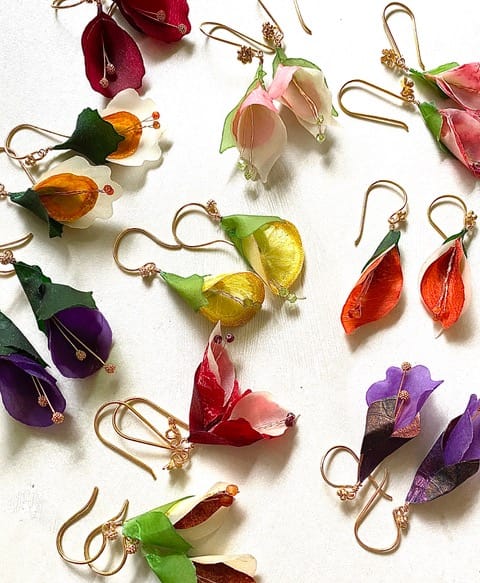
Indeed, more than 45 varieties of fresh produce are the foundation for her translucent, luminous jewelry, sculptural vessels, and glass-enclosed tableware— bowls, plates, and trays. She terms her medium “vegetable parchment,” coining the name because after slicing, curing, aging, and pressing the produce, “the sheets [that emerge] look like parchment from ancient times.”
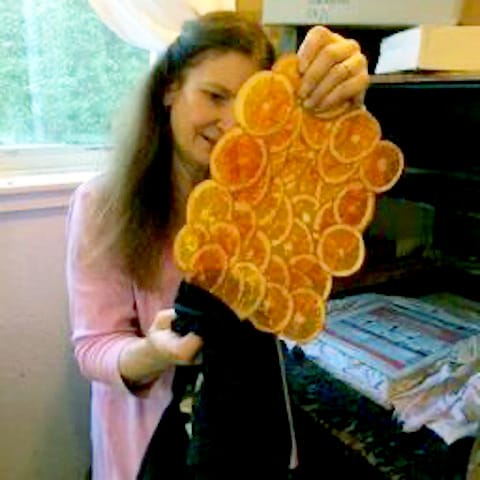
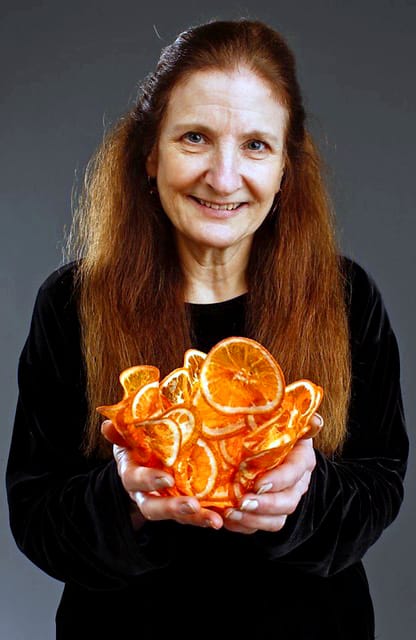
“I buy them when they’re ripe and in season,” she said, mostly shopping at Berkeley Bowl and the Temescal Farmer’s Market. A bag of mandarins from Trader Joe’s graced her kitchen counter. When she needs a larger quantity, San Francisco-based Cooks Company, delivers cases or sacks of produce from local farmers. Luckily, she said, “there are a core of fresh fruits and vegetables that are year-round.”
Dorfman’s work is labor-intensive and physical in the no-frills studio behind her house, where she can look out at the greenery of her backyard. For company, she has her 25-year-old cockatoo, Bintel (Yiddish for a little bundle) no matter where she is, as his three cages hang in her house, backyard, and studio. “Cockatoos are very intelligent,” she cautioned. “They need attention and toys.”
Her time in the studio is spent putting the raw fruits and vegetables through a proprietary process for several days to prepare them for the presses. They are cut into pieces about an inch thick and pressed in a custom-made 200-ton hydraulic press.
“The presses are changed three times daily, and the pressure is gradually increased to 150 or more tons over the 10 to 14 days required to transform the vegetables and fruit,” she said. “The pressure and length of time vary somewhat, depending on the individual variety of fruit or vegetable.”
What remains is just color and fiber, Dorfman said, as all liquid, sugars, starches, and carbohydrates have been pressed out. The pressed parchment sheets, when held up to the light, are so translucent that you can see the actual structure of the vegetables and fruits.
“The resulting parchment-like sheets are either molded into decorative translucent vessels, embedded in glass to become food-safe serveware, or transformed into jewelry,” Dorfman described. She may pair them with semi-precious gemstones, which she folds into fanciful blossom earrings, or fuse them into hand-cut copper shapes, joined to 22K gold vermeil findings, to become colorful disc earrings, necklaces, and cuffs.
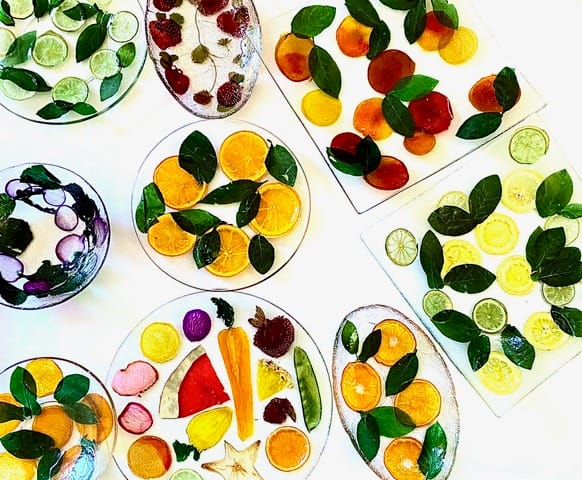
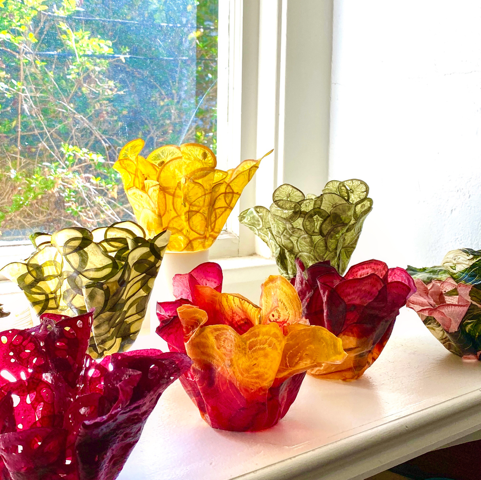
“Tariffs have played havoc,” Dorfman said, because both the glass, imported from Italy, and the gold vermeil, imported from Bali, have gone up in price. “But I’m managing.”
Although Dorfman didn’t set out to be an artist (her parents wouldn’t have approved), “I was always making things ever since I was little, little, little,” she said. “I can’t draw, but I made papier-mâché, I did origami, made jewelry out of pine needles, and crafted sand candles. It wasn’t called art—it was called piddling around.”
A bachelor’s degree in linguistics and anthropology from UC Davis and a master’s in American Sign Language from Cal State Northridge set her on a path as a sign language interpreter. She interpreted lectures for deaf students in classrooms at UCLA, UC Berkeley, and Laney College.
But, one day in 1997, as she was making a meal for her husband, Wayne Pickus, and their young son Simon, she happened to hold a piece of the zucchini she was slicing up to the light and saw its actual structure. And she thought, “How can I capture this?” What followed took a lot of trial and error over a couple of months.
“I tried a lot of different methods. My brother built me my first little press, and after trying a combination of methods that weren't successful, I finally came up with something that worked for me.”
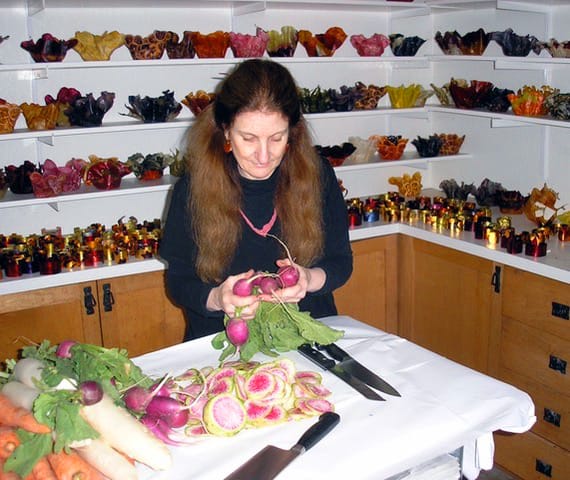
Although she found interpreting for the deaf rewarding, “I had a little boy, I couldn’t do it all. And you can’t really do sign language with stained hands.” So, her art became her full-time job. That was 24 years ago, and now, at the age of 72, it still is. “I love working. I don’t ever plan to stop. I feel fortunate to be doing this. I just love the vegetables.”
“She’s a favorite,” said Phea Hudson, media, marketing, and events coordinator for the Berkeley-based ACCI Gallery, the oldest arts cooperative on the West Coast. “Sometimes I see vegetables on someone’s neck or ears, and I think that’s Margaret,” she said. “Her personality and art go hand in hand.”
“Customers are often fascinated by the unexpected combination of natural elements and fine craftsmanship,” said Monique Rodriguez, whose Old Salt Merchants shop in Elmwood features Dorfman’s designs. “Margaret sources her fruits and vegetables from the beloved Berkeley Bowl, adding a distinctly local connection to her work,” Rodriguez said. “Customers are especially interested to learn that any excess produce is donated to the Oakland Zoo, allowing her creative process to come full circle with virtually nothing going to waste.”
“My entire life is here—my dentist, my CPA,” said Dorfman, who has lived in Rockridge for 42 years. “I’m a big walker, seven to eight miles a day.” Crepevine is a favorite eatery, “it has something for everybody. I love Cole Hardware, it’s addictive. My neighbors are wonderful. Rockridge is just a lovely place to be.”
If you have a Rockridge story that needs telling, please email judyberne@att.net.


