


Doug Yoshida came by his activism by accident….or did he? After practicing emergency medicine at Stanford, Alta Bates and SF General, he took a short stint at Bellevue in Manhattan where he was scheduled for an evening shift on September 11, 2001. Upon hearing of the destruction of the Twin Towers, he rushed into the hospital, only to find there was little for him to do. Few survivors were found in the rubble.
Walking uptown, he recalled seeing people covered in dust, “an acrid smell like I had never smelled” filled the air. Returning to the hospital that night, the emergency room was still largely empty. “Like many others, I think I dealt with a kind of PTSD for some time.”
Weeks later, he was asked to treat an unusual wound on a woman who was sorting mail at a newspaper office. “Anthrax … two days later the New York Times reported the powder in their mail,” said Doug, who was quoted in the article about the discovery.
Years later, in 2011, Doug and his wife Jennifer, a documentary filmmaker, moved to Rockridge for work— Doug, at Stanford Tri-Valley in Dublin, and Jennifer, at The Sacred Land Film Project. Doug’s father, born in San Francisco, worked at the Jet Propulsion Laboratory in the San Fernando Valley as an engineer. His parents participated in fundraisers for Democratic candidates, and supported Shirley Chisholm for President.
When Worlds Collide
You may be thinking…this is the American dream of accomplishment and exploration realized. Think again. The full scope of Doug’s family history was about to collide with his future.
On February 19, 1942, Executive Order 9066 was signed by Franklin Roosevelt. Every person of Japanese heritage in “The Exclusion Zone,” which included all the territory west of the Sierra Nevada and Cascade Mountains, regardless of citizenship, had to register with the federal government.
California Attorney General Earl Warren (later Chief Justice of the U.S. Supreme Court) supported the action insisting that it was impossible to determine who among the Japanese Americans was loyal and who was not. They all had to go.
The Japanese American Citizens League strongly protested the government’s actions, yet, despite obvious constitutional concerns, the organization eventually agreed to cooperate since it was deemed a “military necessity” by top military and civilian officials.
Within months, all those registered were told to evacuate to holding areas until their final destination was determined. They retained only those possessions they could carry. Various orders and regulations allowed their businesses and real estate to be sold without their consent. Eighteen people were ultimately convicted of spying for the Japanese—all Caucasian. None were of Japanese ancestry.
Doug’s relatives were sent to converted horse stables at Tanforan until the camp in Utah was completed. His grandmother had been diagnosed with cancer. His grandfather was eventually allowed a 15-minute visit to see her at a hospital. While there, he recognized several other Japanese American patients whose families did not know their whereabouts, and quickly wrote down as many names as he could.
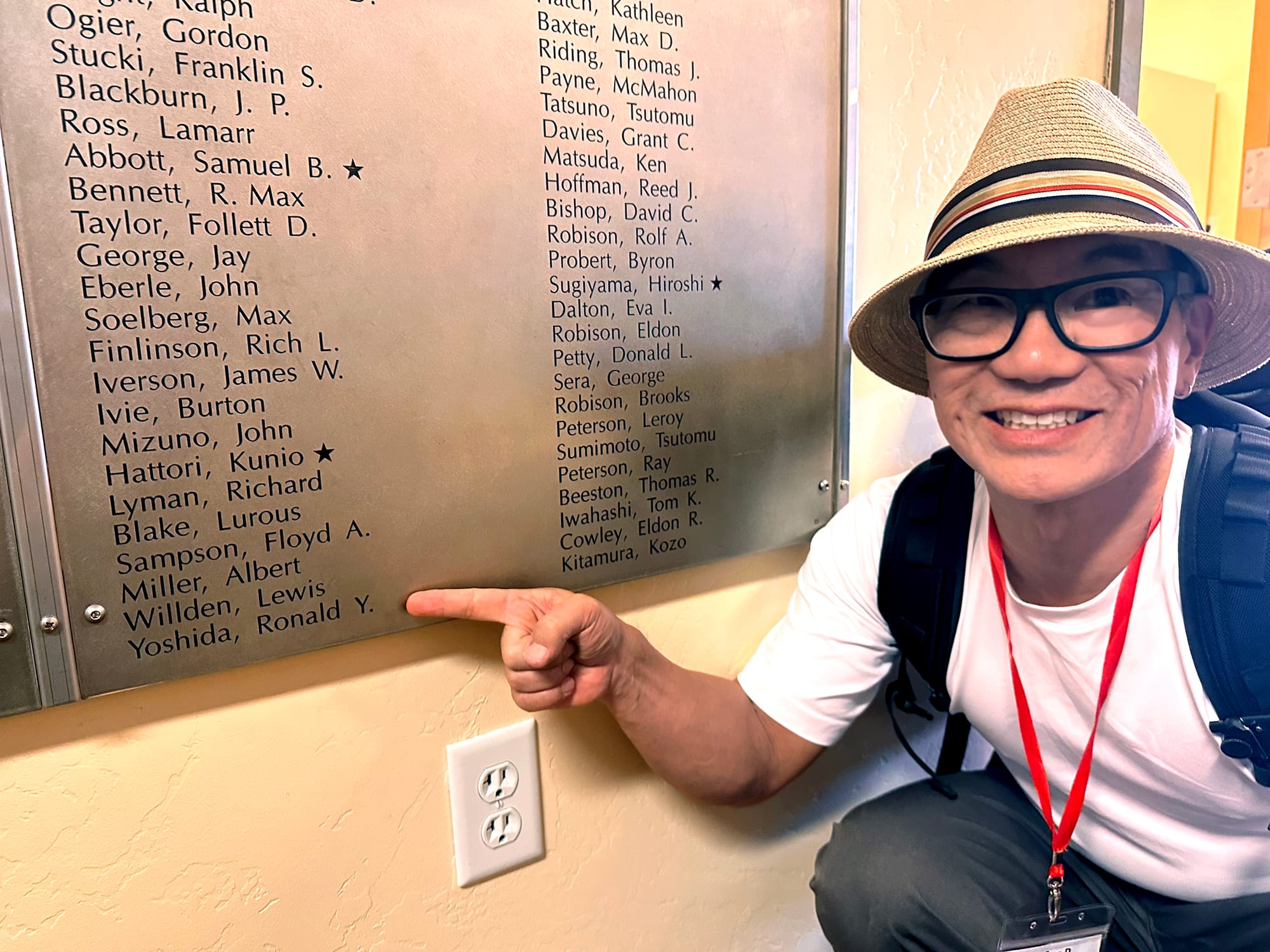
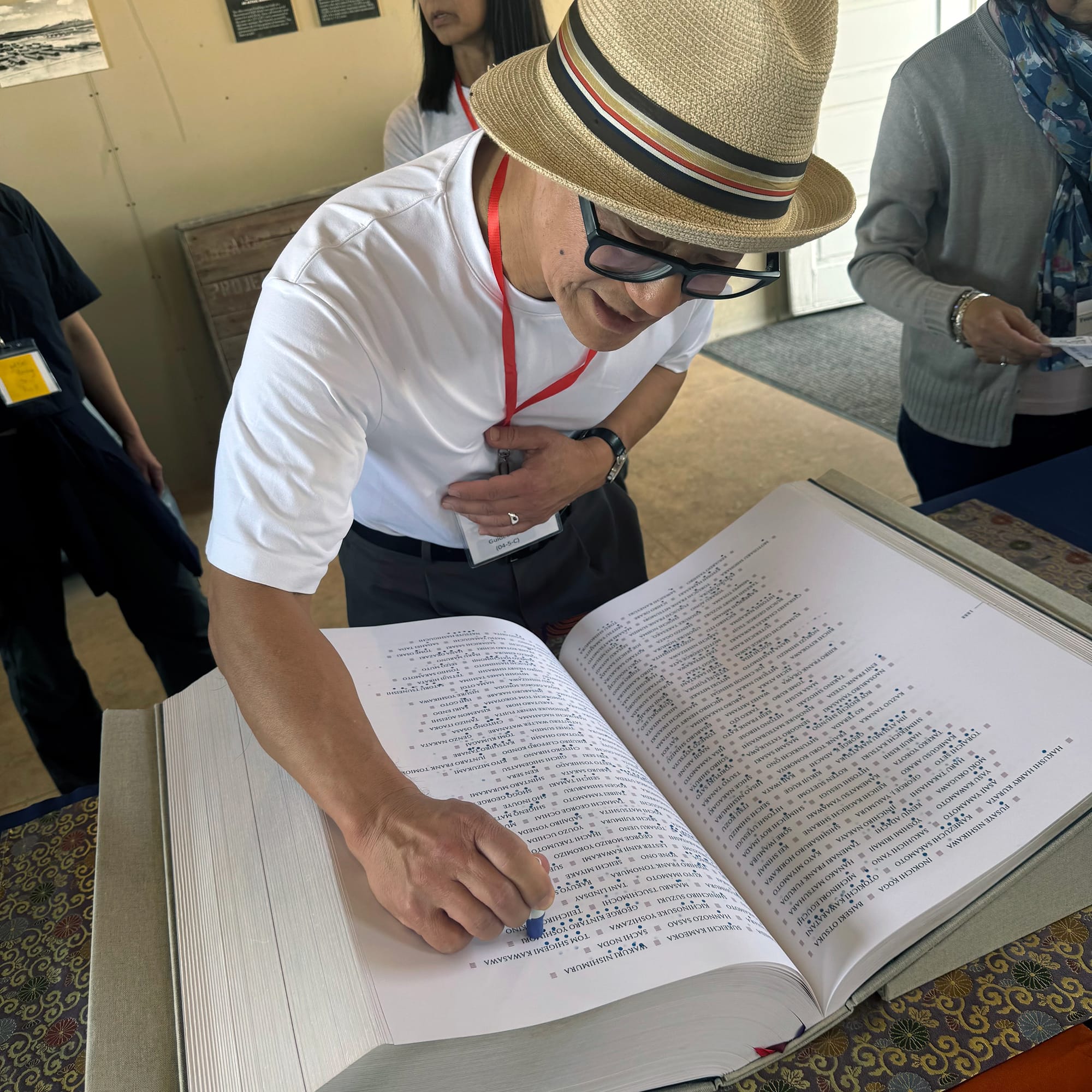
(Photo on left) The memorial to all veterans at the community center in Delta Utah, the town nearest to the Topaz internment camp, was revised to include the Japanese Americans. (Photo on right) The Ireichō, often called the Book of Names, is a memorial that contains the names of every known person of Japanese ancestry—more than 125,000 individuals—incarcerated by the U.S. government during World War II. The book is touring, and people can put a stamp next to family members or people they know. Photos: Jennifer Huang
Because of his mistrust of the FBI, he sent the names in a letter to the Swedish Embassy via a lawyer who could help contact the families. Doug’s father was only 15 when he arrived at the Topaz internment camp in Utah, which held over 8000 people. The family spent three years there and all survived, except for his grandmother due to inadequate care for her cancer.
Doug’s father was given an early release from the camp through a program established by various nonprofits. When the war was over, however, he was drafted to be a translator for the US Army in Japan. After his service, he studied mechanical engineering at Rensselaer Polytechnic Institute and at MIT. Throughout Doug’s childhood, his father rarely discussed his experiences in the camp.
Activism Reignited
Last year, Doug was providing medical care to incarcerated people at the Federal Correctional Institute (FCI) in Dublin and at the Santa Rita Correction Center when he learned that the Department of Homeland Security intended to convert FCI into a detention center for people detained by ICE. He knew that an influx of patients under such conditions would strain the system.
He could see that a potential crisis was building and that somatization (physically internalizing the trauma as pain and anxiety) needed to be addressed. Recognizing the parallels to his family’s history, he attended rallies for immigrant rights, and approached an attorney who spoke at one of the events—offering his assistance based upon his personal observations and experiences.
The attorney asked him to write an op-ed for The SF Chronicle, which he did with his wife’s assistance. A rally organizer who read the article contacted him soon after about speaking at City Council and County Supervisor meetings. “This is the one area where I can do something,” he realized.
To date, Doug has spoken at approximately 11 local government meetings and rallies. He has also helped provide medical assistance to rally attendees—important for the largely senior-aged attendance.
“I am an accidental activist. It’s part of who I am now,” Doug confides, and plans to continue to write and speak wherever he thinks can make a difference.
Doug continues the legacy of righteous determination bequeathed by his family. His advice for anyone interested is “choose an issue where you have expertise…do what you can…do something a little bit out of your comfort zone …it prevents dementia!”


