


“What is that cool tall purple-flowering plant?” is one of the most common questions I get this time of year when I’m down working in the Frog Park Climatescape or when someone walks past our front yard. Invariably, passers-by are referring to Nepeta tuberosa, a Mediterranean plant native to Sicily and the Iberian Peninsula.
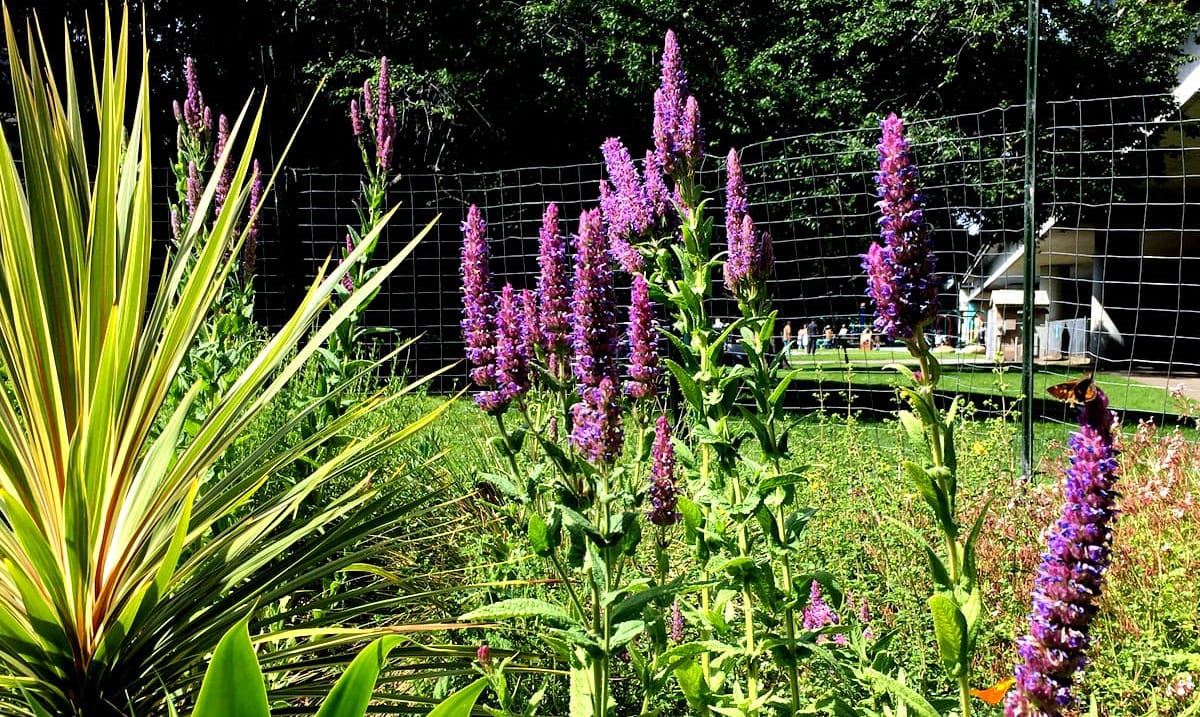
A species of catnip, Nepeta tuberosa’s name actually refers to the large tuberous taproot it forms over time, which stores moisture and energy for the plant so that it can get through the long summer dry season. Once the dry season really sets in, the tall flower spikes and leaves will dry out (cut them back at that point), and the plant will go into a slumber, disappearing underground and waiting for the fall rains to begin, at which point it will send out clusters of fuzzy grey-green leaves near the base and begin its slow build back to flowering in late spring.
While we are hard-wired to believe that what all plants really want, if given the choice, is rich, fertile soil that is evenly moist year-round, Nepeta tuberosa is a very good example of how this is not the case at all. Our world’s plants have evolved within a range of soil conditions—even including heavy clay—and Nepeta tuberosa has evolved to thrive in low-nutrient, gravelly soil. If your soil is heavy and/or too rich, and too wet, the plant will likely be short-lived in your garden, giving a good show the first year but not coming back the second.
In the Frog Park Climatescape (where you can really see Nepeta tuberosa in bloom right now), I created a custom seed mix of California wildflowers along with Nepeta tuberosa seeds and broadcast the mix over the site after we had planted the main plants but before we put the gravel mulch down.
Where it has sprouted is simply where it has wanted to grow. It turns out the gravel mulch has provided the perfect low-nutrient, free-draining growing medium for the plant, and now the plant is dotted throughout much of the site.
All manner of bees (especially bumblebees), butterflies, and skippers love the flowers. Bees have to learn how to access pollen and nectar in each new kind of flower they visit, so learning the layout of one kind flower and then going from one to the next quickly and efficiently is what they prefer.
Each flower spike on a Nepeta tuberosa plant is made up of many individual flowers, thus providing the perfect one-stop-shop for pollen and nectar for a bumblebee who wants to be zippy and efficient with its foraging.


