


(aka California Buckwheat)
By this time in the mediterranean garden, things are getting dry. As a result, most plants are well into their late-summer dormancy, waiting for the first rains of the fall. Although we have had one fairly decent rain in the Bay Area in early September, we haven’t seen any since.
In most plants, you probably won’t see profuse blooms at this time, as they are conserving as much energy as possible. However, some plants do surprise you and manage to keep blooming late into the dry season—even without supplemental irrigation. Eriogonum fasciculatum (aka California buckwheat) is one such plant.
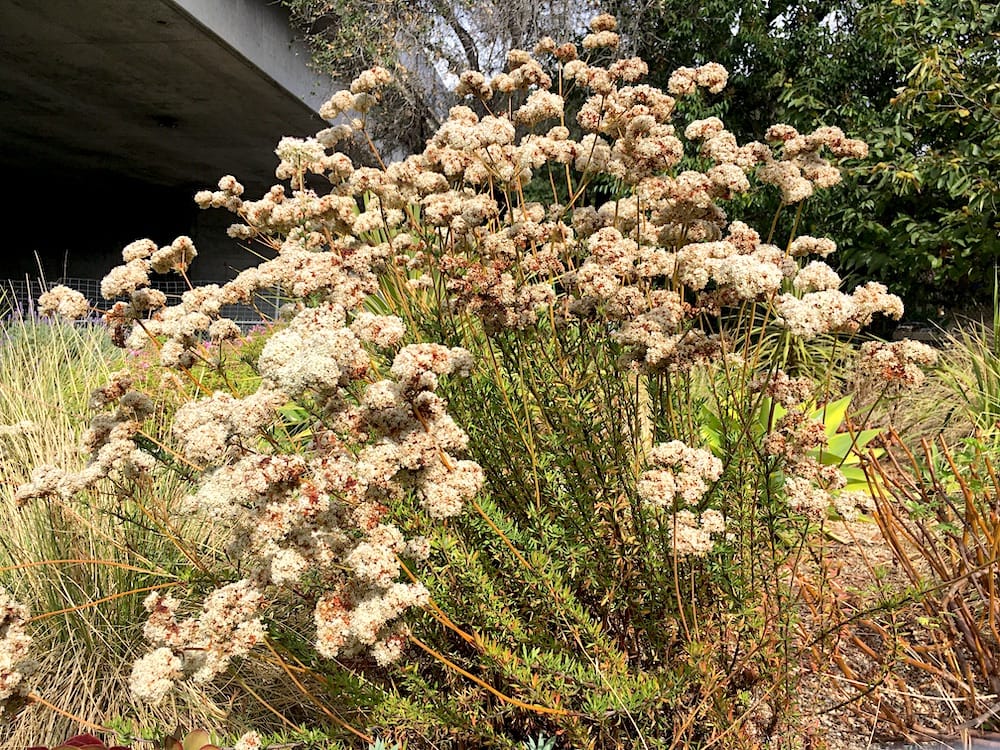
In late July or early August, they will shoot out a profusion of white pom-pom-like clusters of flowers, at a time when most plants are really winding down their blooming for the season. And once they start blooming, they tend to keep going, sometimes for two months on end. Then cue the arrival of a huge range of pollinators—from your typical honeybees to the otherworldly-looking, shimmery-black, pollinating great black wasps, to everything in between.
The foliage of the plant looks very similar to that of rosemary, but the shape of the plant can get quite sprawly over time if left to its own devices. In the Frog Park Climatescape here in Rockridge (by Hardy Dog Park), the Eriogonum plants get a hard pruning once in early fall, and then a second pruning a couple of months later. In this way, the plants maintain a tidier shape and can serve as accent marks or punctuation points in the garden, rather than a shapeless mass.
Remember, we as humans are hardwired to want to immediately find patterns and definition within new landscapes we come upon—a remnant of when we lived of in wild and had to quickly assess the relative safety of the new environments we encountered—and thus we don’t innately like thickety-looking spaces (even if, on a rational level, we now know thickets are good for wildlife).
As always, work to strike a balance between what you want to see and what the critters want, and you’ll end up much more satisfied in the end. Leave the thickets for habitat-restoration projects.


