

Some years ago, when I was playing golf as a guest at the Claremont Country Club, I noticed the large body of water in the quarry adjacent to the tenth fairway. It was during a period of drought when water was on everyone’s mind, and, as a director of another country club, I was acutely aware that our biggest expense was water—some 60 to 70 million gallons annually of pure, fresh mountain water purchased at ever-increasing prices from the East Bay Municipal Water District.
“Whose water is that?” I asked, in a tone that was more demanding than interrogative. “It’s ours,” responded my host, doing his best not to appear smug. “We’ve been watering the course from it as long as I can remember.”
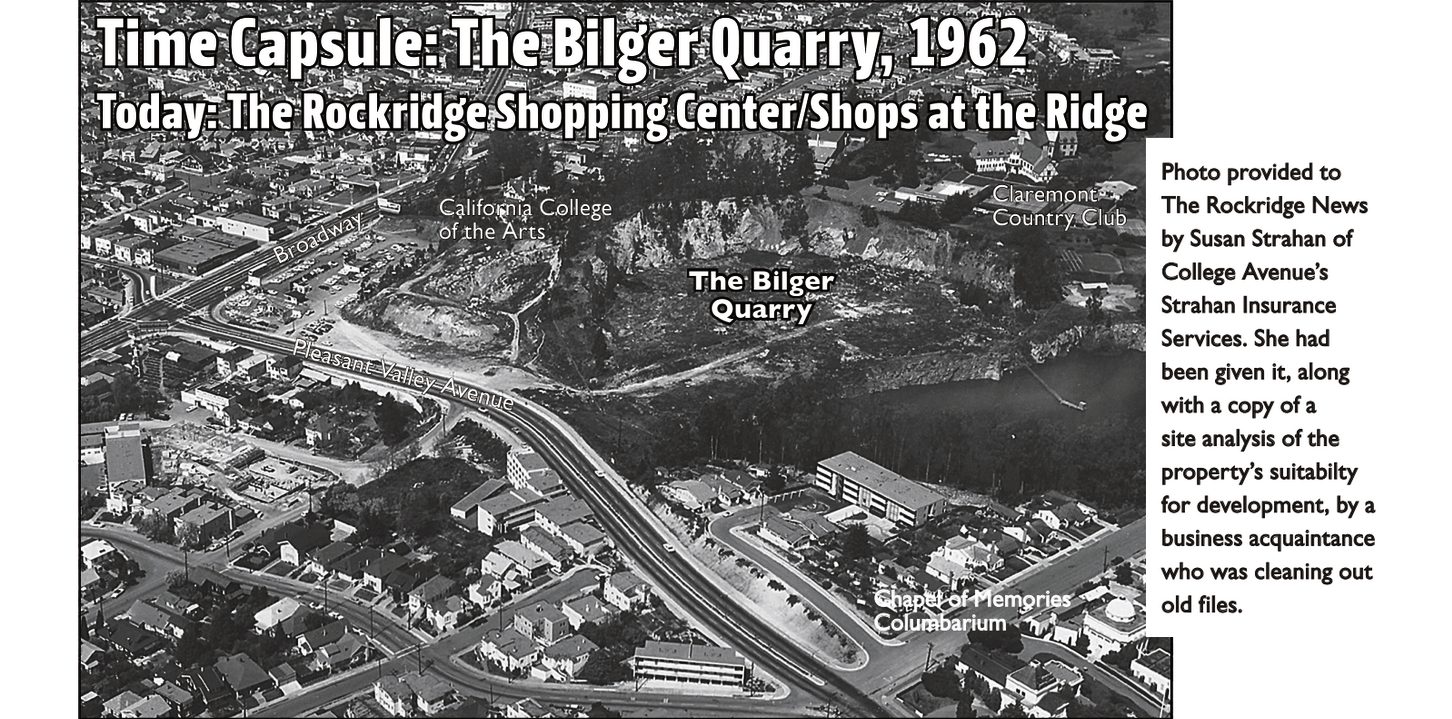
Indeed, it was much longer than his memory, for in 1932, Charles Beardsley, a man with keen foresight, advised the country club to buy the Bilger Quarry and its water rights, which for the past 92 years have provided water for the golf course’s fairways and greens.
The pond is filled by groundwater and the Rockridge branch of Glen Echo Creek. The club never drains the reservoir dry, using only approximately half of the water each season. Using the quarry for its irrigation avoids a huge drain on EBMUD’s resources.
While researching this article, the legal concept of “attractive nuisance” entered my plaintiff lawyer’s mind—the quarry is a very attractive but dangerous place to explore. Indeed, in 1955, when three young boys climbed over a broken part of the fence along the side of the quarry, one of them fell into the pond and drowned. In 2012, an Oakland man’s attempt to rescue his cat ended tragically when he fell from the quarry-side cliff and drowned.
A fall into the pond is extremely dangerous, for the sheer rock walls make it difficult, if not impossible, to climb out. The stories of ventures into the dangerous confines of the quarry do not all end in tragedy. In 1980, under the cover of darkness, someone rappelled down the east quarry wall and painted a large white question mark on it. The graffiti remained visible for years.
Excavation of stone began in 1864, mining on the eastern end for quartz diorite, a purplish igneous rock, said to be practically indestructible. The Bilger family had operated a quarry in Germany. Bilger dropped out of medical school, kept the books for the quarry, and acquired it with a gentleman named Black, and eventually, it became known simply as Bilger’s Quarry.
It was key to Oakland’s early development; the city’s first paving contract specified the quarry as the source of crushed rock for macadam (a type of road construction) paving, which would last for eight or ten years without repairs. The western end yielded Franciscan sandstone, used for landfill as Oakland expanded into the marshes.
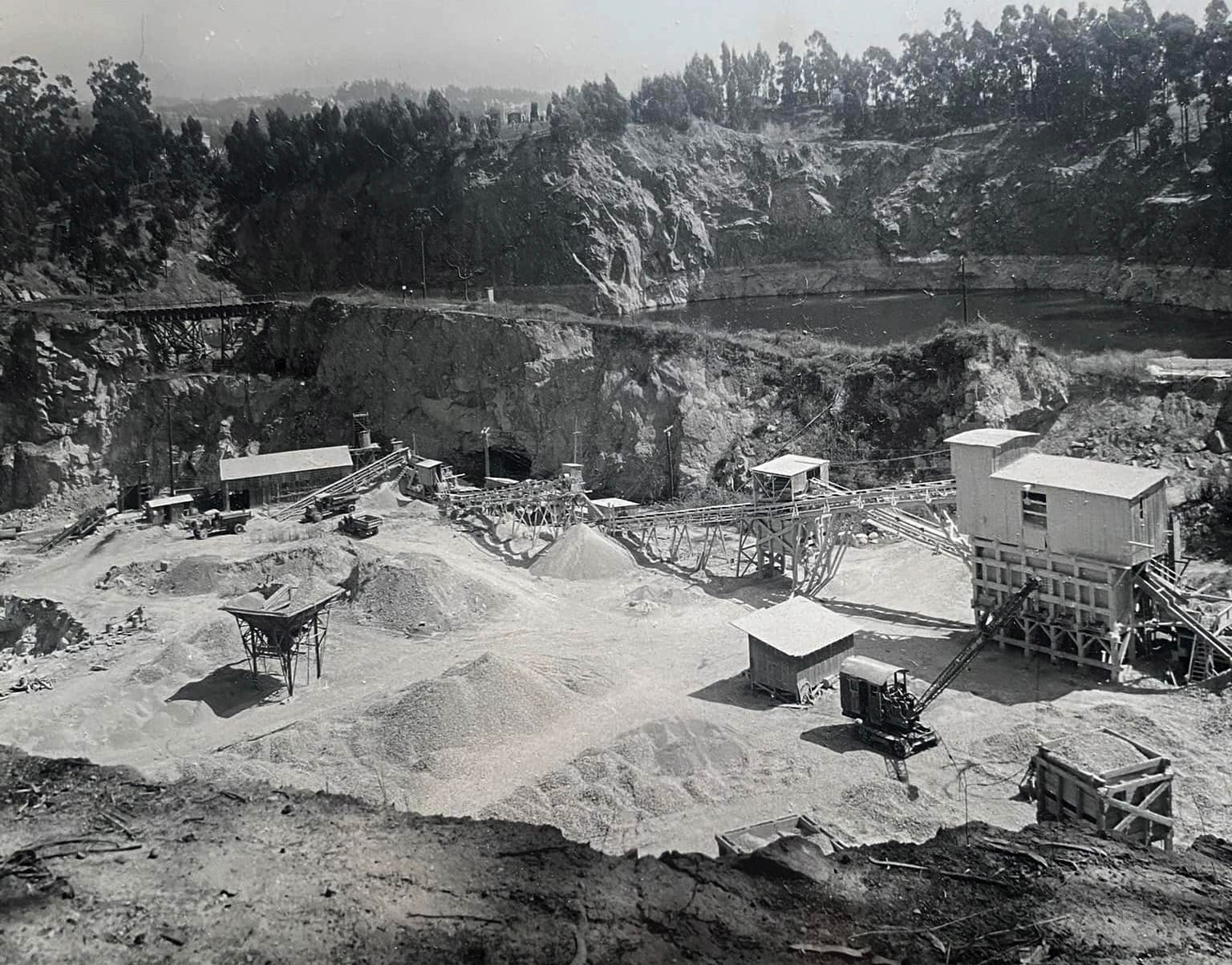
Between 1864 and 1946, the quarry operated steadily, with a few inactive periods, serving as the largest supplier of rock in Alameda County. Not only did it provide paving material, but it was also the source of crushed rock for building foundations, concrete aggregate, and streetcar roadbeds.
Mining consisted of drilling 18-inch holes into the ground, and steam-hoisting rock out to be crushed by workers swinging heavy sledgehammers. The quarry averaged about 250 cubic yards of crushed rock daily, a volume equivalent to two average backyard swimming pools. All of the crushed rock was sent by railway to a depot at 41st and Shafter, where it was taken by train to parts of Oakland and beyond.
The quarry provided work for many immigrants, especially from Italy, who built many of the brick and stone structures in Oakland and Berkeley’s older neighborhoods. If you ever visit the Lake District in northern Italy and have your morning espresso at an out-of-the-way café, you just might be seated next to the descendant of one of the skilled stonemasons from Como who immigrated here and found work in the quarry. Of course, you needn’t travel to Italy to meet a descendant of those early stone workers. It’s likely that you could meet one or more in Oakland’s Colombo Club or the Fratellanza Club.
The quarry was abandoned for many years, but in 1981, construction of the Rockridge Shopping Center adjacent to the quarry commenced. If you aren’t in a big hurry after shopping there, walk over to the eastern side of the parking lot and explore—visually, that is—the quarry. Soak up a little sunshine and Rockridge history.
As one observer artfully described, “The deep part is filled with water. When the weather is warm enough, insects hatch and start swarming, cliff swallows appear and nest on the quarry walls. They can be seen swooping and catching insects morning and evening.”


