


In 1986, while working at Lawrence Berkeley National Laboratory, 36-year-old Cliff Stoll was asked to research a 75-cent accounting error in a computer log — a tiny discrepancy that would consume the next ten months of his life. His dogged pursuit uncovered a German hacker siphoning U.S. defense secrets to the KGB and became the basis for his best-selling memoir, The Cuckoo's Egg: Tracking a Spy Through the Maze of Computer Espionage, a defining account of the internet's lawless early days.
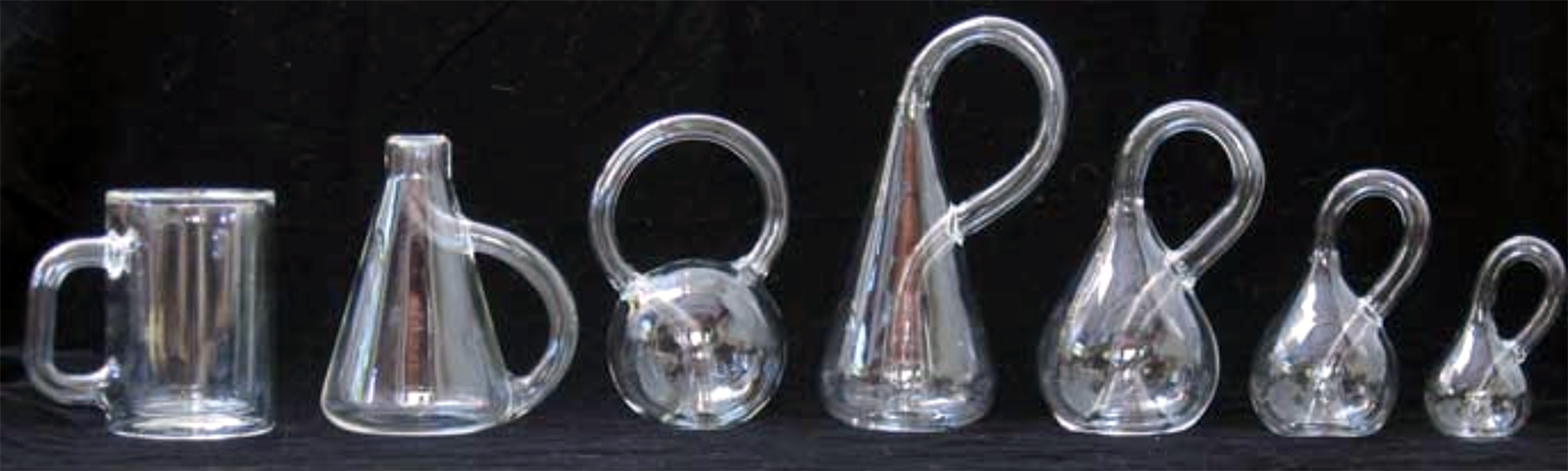
But long after exposing spies and warning of the coming digital future in books like Silicon Snake Oil, Stoll found his most enduring obsession in an unlikely shape: the Klein bottle, a paradoxical geometric form first described by the 19th-century mathematician Felix Klein — a surface with no inside or outside, where boundaries dissolve and everything loops back on itself.
The form grows out of the same mathematical ideas as the Möbius strip — a loop created by twisting a strip of paper 180 degrees and joining the ends — extending it into a closed surface with one edge and no sides.
Klein showed how such strips could be combined to create a curious shape that seems to defy basic mathematical logic, reminding us that whatever is “inside” continually flows outward to shape the world, and vice versa. Stoll says our three-dimensional world ignores a fourth-dimensional reality, because in three dimensions, it appears to pass through itself. That visual paradox exists because we cannot fully represent its true four-dimensional structure.
For Stoll, mathematics is not just abstract theory but lived experience. He compares it to music — something you can appreciate without mastering. His favorite field, topology, studies properties of shapes that remain unchanged when stretched, bent, or twisted — but not torn. “It’s an odd kind of mathematics,” he explains. “It doesn’t deal so much with numbers. It deals with something more fundamental — how many edges something has, how many sides, what makes a surface continuous.”
Over the years, Stoll has turned that fascination into an unusual business — Acme Klein Bottle. He sells the glass bottles, which range from tiny three-inch earrings to dramatic three-foot sculptures. Though he once made them himself, he now commissions skilled glassblowers to produce them in batches of two or three thousand at a time to get the best price. Storing that many fragile objects presents a challenge, so he keeps them organized in boxes beneath his home.
Cliff built a robotic helper to store and retrieve bottles stored under his home in Rockridge. Video: Anna L Marks
Through a small hidden door in his workshop floor, Stoll deploys a robot he designed and built to retrieve his inventory. He constructed it from parts sourced from old cars and at Cole Hardware, and powered it with motorcycle batteries. He provided the low-slung vehicle with tilt-and-lift motors and multiple cameras, including a backup camera. This allows him to access his bottles easily, without the need to rent warehouse storage space, and to keep careful track of each piece.
“Every day I sell a few. I deal with mathematicians around the world,” he says. “The Bay Area — Berkeley especially — is a hotbed for math. Where there’s math and mathematicians, there’s a demand for Klein bottles.”
Stoll has experimented with variations, including a striking triple Klein bottle — one nested inside another — created in collaboration with two other glass artists. Never content to stop there, he has also knitted Klein bottle shapes into wool hats and infinity scarves, merging craft and calculation.
Stoll and his wife lived on Colby since the late 1990s, raising two children (both attended Oakland Tech). His late wife, an artist, was his creative partner in nearly every sense. Together they restored their home into a deeply personal work of art — designing hand-cut tiles adorned with fish and calla lilies for walls and floors, including those in a small in-law cottage at the back of the property. She also dyed fabric for his handmade quilts, which are scattered throughout the home.
The house remains filled with handmade items, books stacked in improbable towers, mathematical curiosities, and cherished objects collected over decades — all with a story to tell. “How do you move forward when your heart is so tied to a place like this?,” Stoll asks.
As Cliff Stoll considers what comes next, the answer may lie in the very object that has captivated him for decades. The Klein bottle — first imagined by Felix Klein — has no clear boundary between inside and out; it insists that endings are also beginnings, that what seems to pass through itself is simply part of a larger dimension we cannot yet see. Like the elegant loop of the bottle itself, his life’s work suggests that nothing truly breaks — it bends, it twists, and, somehow, it carries on.


