


by Judith Doner Berne
As two luxury senior housing projects loom over Rockridge, 60 or so attendees listened intently to and had questions for a panel dedicated to affordable housing Thursday night at the Rockridge Library.
Described by moderator Kristen Belt as “an all-star cast,” Felix AuYeung, chief real estate officer of Habitat for Humanity, Alicia (Ali) Gaylord, senior vice-president at Affirmed Housing, and Oakland’s Housing and Community Development Director Emily Weinstein provided insight into requirements for affordable housing: land, public processes, and funding.
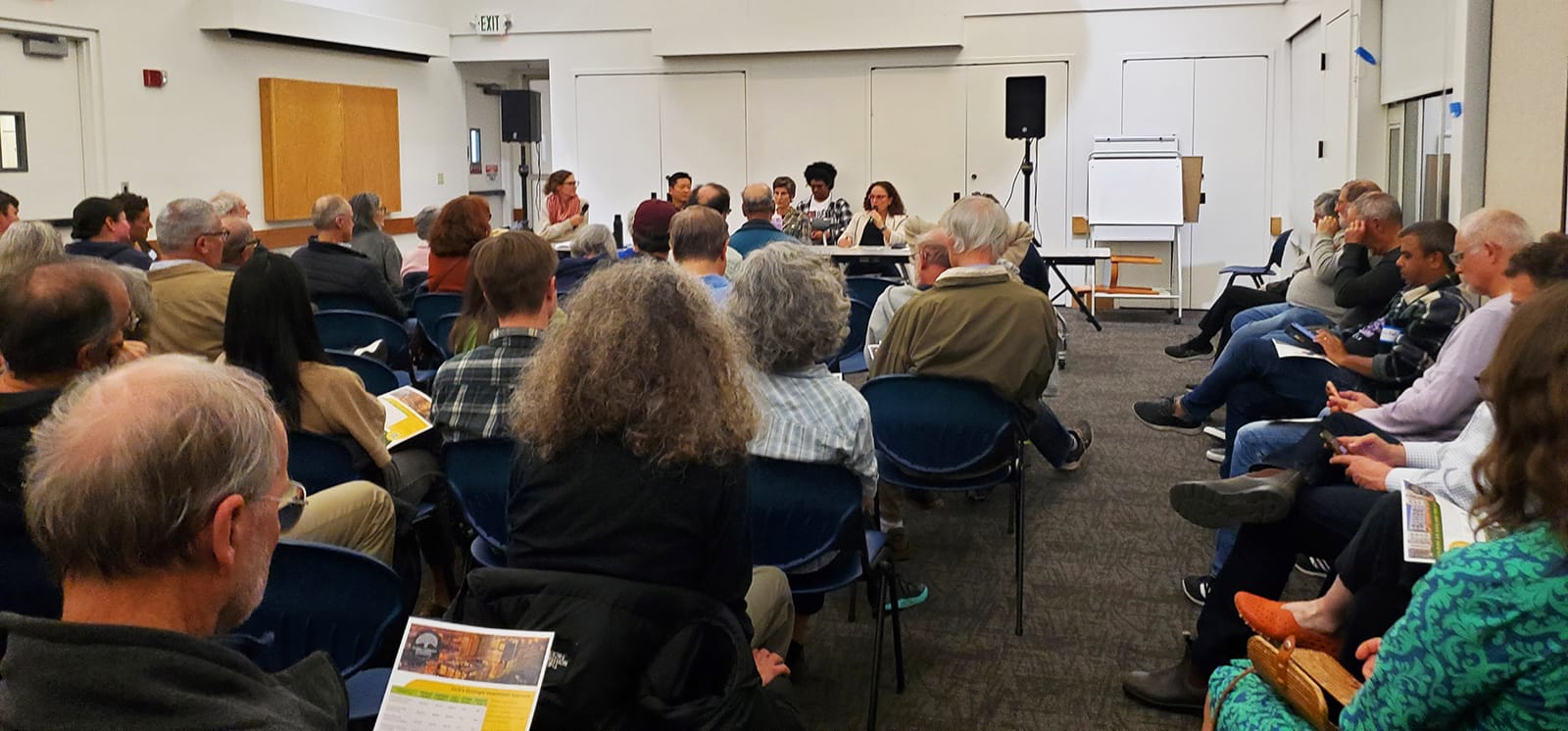
The session, sponsored by the Rockridge Community Planning Council (RCPC), is one of a series of community meetings stemming from last year’s Community Vision Plan, according to host and RCPC chair Jana Good.
Following a general discussion of the definition, difficulties, and dividends of affordable housing, Belt, an architect and RCPC vice-chair, steered the conversation to what directly affects Rockridge:
Voter-approved propositions like Measure U, passed in 2022, have resulted in Oakland leading major Bay Area cities in permitting deed-restricted affordable housing. That $850 million bond issue dedicated $350 million specifically to creating, acquiring, and preserving affordable housing for 2,200 to 2,400 units. But, “We’re almost at the end,” Weinstein said.
“With 4,500 homeless on the street, Oakland does not lack for projects. Twenty projects in the pipeline are all in need of funding,” Weinstein continued.
Habitat for Humanity tried to buy the former Red Cross site, now proposed for market-rate senior housing and currently under Oakland Planning Department and Planning Commission review. “Market rate developers could offer what we couldn’t,” AuYeung said.
Impact fees from senior housing developers of the Red Cross and Trader Joe’s sites will go toward affordable housing in Oakland, Weinstein, who lives in Rockridge, said. From 2021 to 2025, Oakland generated $28 million in impact fees for affordable housing.
District 1, which includes Rockridge, hosts 10 percent of Oakland’s affordable housing, she said. This includes the Idora Apartments (33 units), converted into housing for Oakland Unified School District’s teachers and staff, bordering Rockridge at Claremont and Telegraph, which opened in April.
Within Rockridge, Clifton Hall (41 units), at Broadway and Broadway Terrace, houses seniors over 62 who were formerly homeless or at risk of homelessness. Oakland bought that building, a former dormitory, from the California College for the Arts in 2021, but Weinstein noted that the city wouldn’t buy a property again. Instead, they sign leases that guarantee a building’s affordability for at least 55 years.
“What would you do with the 51st and Broadway site,” was among the questions asked by audience members. “Something that big would need a group of investors,” AuYeung said. “It’s very hard to wrestle landowners—unless the landowner wants to donate the land,” he said with a wry smile.
Audience members interviewed were impressed. “It was very interesting to see the different aspects of it [affordable housing],” Rockridge resident Ross Nolan said. “I learned more about the success of Proposition U,” said Leah Rothstein, who is active in the Oakland Community Land Trust. And Sara Benson, a Rockridge resident who said she attends a lot of community meetings, enjoyed the presentation.
In answer to “What can Rockridge residents do to help,” the panel’s main theme was: “Rockridge can push forward a new bond. And when affordable housing is on the ballot, support it.”


