


Justin Williams and his wife, Hieu, were working from home on a recent Friday afternoon when something unusual captured Justin’s attention outside the windows of their Contra Costa Road home.
The couple grabbed a handy pair of binoculars and zoomed in on a majestic great horned owl, apparently entangled and struggling to free itself in a redwood tree high above Lake Temescal.
What to do? Who to call? They tried the Park District but were unable to reach anyone. They called numbers at Tilden Park and Oakland Animal Services, to no avail. They also reached out to their aunt, Rhita Williams, a known animal lover and part of the local “rescue community.”
Word spread about the challenging situation. The Fire Department was alerted and outreach was made to Craig Nikitas, who runs Bay Raptor Rescue, as well as a bird rescue specialist named Valerie Wayne.
Rhita, who lives nearby on Buena Vista Avenue, then beat a path toward the lake and was on scene when the fire engine arrived. It quickly became apparent that their 75-foot ladder was not nearly long enough to reach the distressed bird, which was dangling an estimated 150 feet above rough terrain. They realized they needed someone to climb the tree. The idea arose to call several arborists and see who could respond the fastest.
Nobody knew how long the owl had been stuck, and there was a slightly panicked feeling among neighbors because it was getting late in the afternoon.
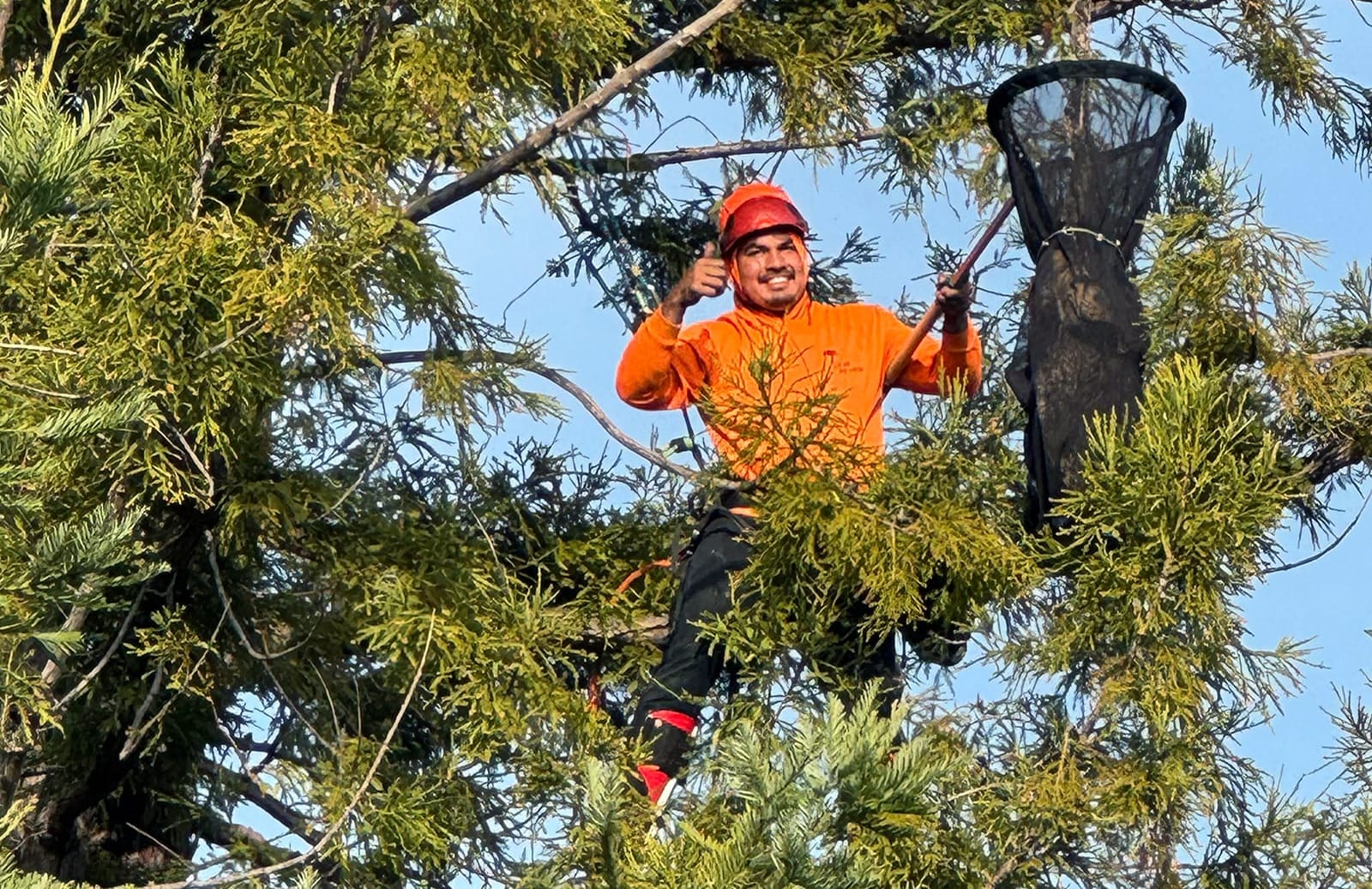
Rescue professionals know that only a few local arborists will attempt animal rescues, including Julian Tree Service in Richmond. Their crew arrived in about half an hour. They surveyed the situation, and Wayne gave the crew a quick lesson in using a capture net she had brought to the scene.
The hastily trained climber showed dexterity and bravery around the bird and its sharp talons. In a few minutes, he corralled the owl in mesh netting and used scissors to cut several strands of fishing line that had ensnared one of the owl’s wings.
Once lowered to the ground, the owl was transferred from the net into a cardboard carrier, and Wayne rushed the raptor to Lindsay Wildlife Hospital in Walnut Creek, where years earlier she had discovered a second career following her work in the broadcast news industry.
“Unfortunately, these fishing-trash injuries are all too common,” Wayne explains. “And we only find and rescue a small fraction of the birds and other animals that get entangled or swallow hooks and lures.”
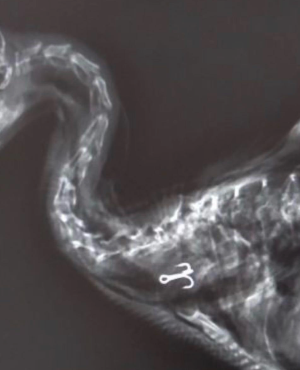
Indeed, Rhita has seen her share of sad and tragic wildlife injuries and deaths on her walks around the park with her three-legged dog, Bert. She shares pictures of a goose that has been around the lake for years with an amputated leg as a result of fishing-line entanglement. She also has an X-ray image of a duck she took to Lindsay that had swallowed a three-pronged hook.
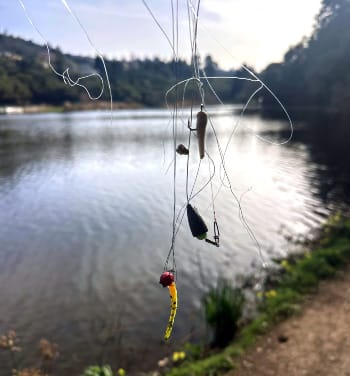
The Park District stocks the lake each year with rainbow trout for recreational fishing. It has also installed several “recycling stations” for dangerous monofilament fishing line. But inevitably, many anglers leave their lines snagged in shrubs and small trees around the shoreline or in the water.
Proper disposal of fishing line is very important. Use monofilament recycling bins where provided. Otherwise, cut used line into six-inch strands before disposing of it in secure trash containers. Always try to retrieve snagged line, whether it’s yours or found.
A post on Nextdoor about the owl incident garnered well over 200 replies from concerned neighbors. Many questioned the Park District’s program of stocking the lake and encouraging fishing there. Some expressed nostalgia about fishing at the lake over the years. A few felt fishing should be banned in favor of preserving the resident wildlife.
“Whatever can be done to encourage more rigorous management of the fishing-trash problem at the lake would be amazing,” says Rhita. “But if that continues to be unsuccessful, I think making the lake a true wildlife refuge, without fishing, is the only course to protect them from injury and death.”
Meanwhile, the great raptor remains under observation with wing and shoulder injuries at Lindsay Wildlife Hospital. There is hope for its eventual release, but there are no happy endings for the thousands of other wild creatures that are snared by or ingest fishing trash.
If you spot an injured animal or want to support animal rescue and rehabilitation, check out these agencies:
- Lindsay Wildlife Hospital and Museum www.lindsaywildlife.org
- Bay Raptor Rescue www.bayraptorrescue.org
- Yggdrasil Urban Wildlife Rescue www.yuwr.org
(Special thanks to Justin and Hieu Williams who rushed into action and generously paid the tree service company.)


