


I’m sure you’ve experienced this: you’re out walking your dog or enjoying a leisurely stroll with a friend when suddenly—there it is, hiding in plain sight. You wonder how you’ve lived so long without it. You can’t help but rejoice in your find, imagining it as a new addition to your home, office, garden, or wardrobe.
Discovering items curbside is not only thrilling; it’s also a sustainable way to breathe new life into things others have discarded. As the saying goes, “one person’s trash is another person’s treasure.”
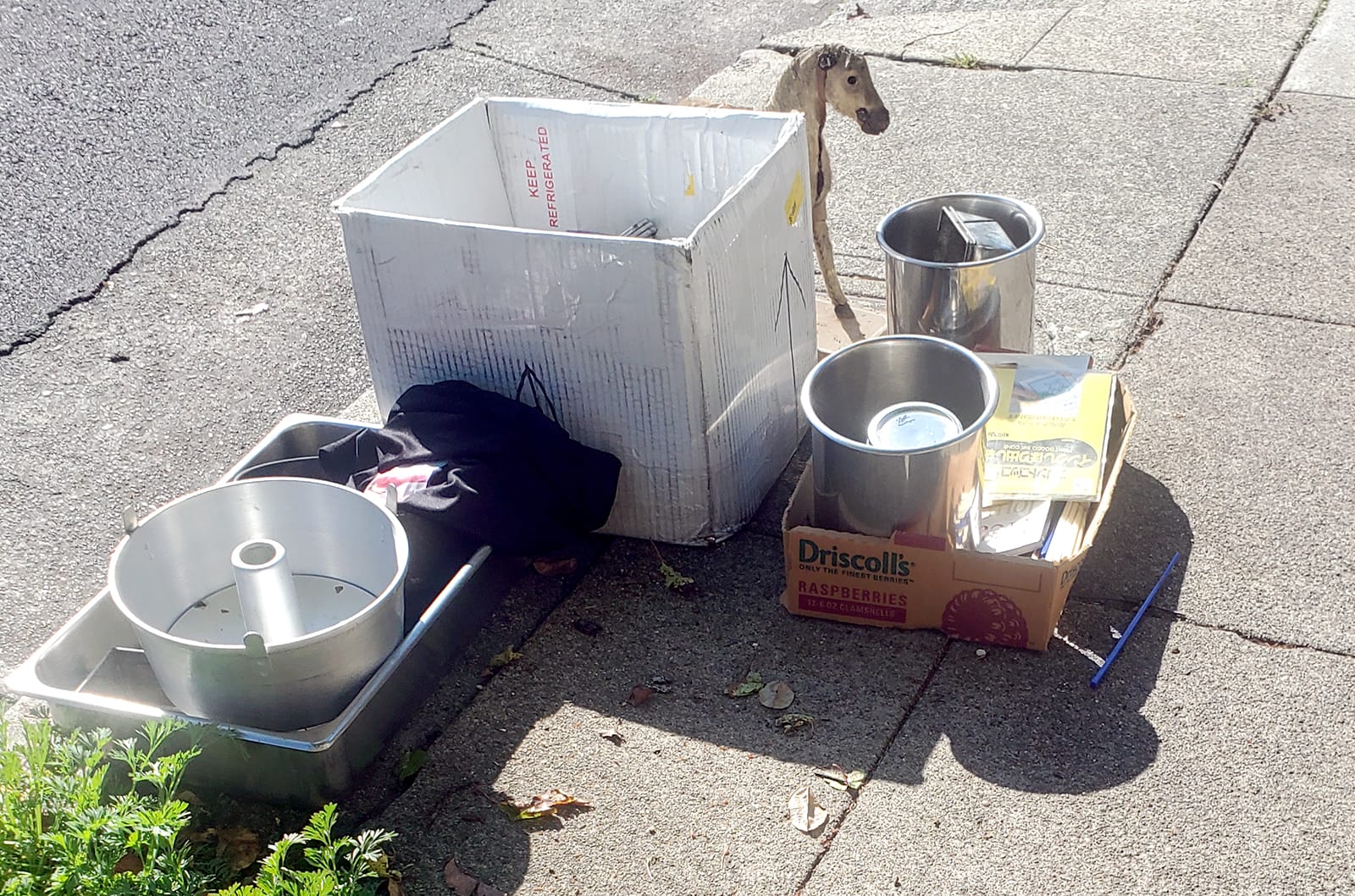
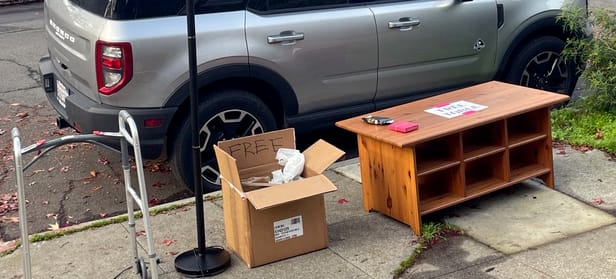
Here’s a partial list of items my husband and I have left on the sidewalk in front of our Hudson Street home for anyone to take:
- An IKEA coffee Table
- Wrapping paper
- An old walker
- Books and clothing
- Desk lamps
- Stuffed animals
- A large corrugated aluminum sheet
Almost everything was taken within a day, though we don’t know by whom. That’s the beauty of curb mining—the informal practice of collecting discarded items left on the curb for reuse or resale. It may also be referred to as curb shopping or urban scavenging. It’s very popular in Rockridge!
While nobody knows exactly when curb mining started, it has been practiced in Japan, Western Europe, and many American cities for decades. College towns are hotspots, especially during move-out weeks.
During World War I and World War II, scavenging and reuse were actively encouraged to support the war effort. After these wars, cities began scheduling bulk trash pickup, unintentionally formalizing curb-mining opportunities.
In the digital age, online platforms such as Facebook and Craigslist have publicized where one might find treasures on the sidewalk. More recently, concerns about the effects of consumerism on climate change have also made curb mining more socially acceptable.
Not all communities encourage curb mining. In fact, most HOAs prohibit it. Several of our friends who live in condos have given us their discarded items to put out on Hudson Street, a popular pickup spot for cars, pedestrians, and bicyclists with a keen eye.
In addition, regulations at the city or county level may prohibit curb mining, as is true in a number of small towns in California. A U.S. Supreme Court ruling has said that items placed on the curb have no reasonable expectation of privacy, but local laws may still prohibit taking them.
In Oakland, individuals are not supposed to take items left out for authorized collection services, such as recycling or bulk pickup. Nor are they authorized to take items that are still under a property owner’s control, such as lawn furniture. (My husband almost walked off with a stool once—until he realized someone was moving it into an apartment on College Avenue.) Still, plenty of Rockridge residents love the informal exchange of items they either leave out or pick up on our sidewalks.
Famous artists, such as Robert Rauschenberg, have found materials for their art on the street (in his case, New York City). My husband, an assemblage artist, has found the following treasures for his own projects on the sidewalks of Rockridge:
- A blue, legless metal ironing board (still waiting to inspire a project)
- An articulated wooden hand for sketching (now in a piece called Taradiddle)
- The top door of a washing machine (which he removed with a screwdriver; now part of a piece called Strong and Weak)
- An old wooden Pepsi bottle case (used for a piece called Dolorous Drolery)
To learn more about my husband, Dare Porter, and his assemblage work, visit dareporter.studio. Meanwhile, if you haven’t already, consider joining the community of Rockridge curb miners.


