


The Greater Rockridge Neighborhood Crime Prevention Council (NCPC) met February 12 in a hybrid session at the Rockridge Library to review neighborhood safety trends and city updates. The volunteer group meets the second Thursday of every other month, and serves Beats 12Y and 13X.
Guests included Councilmember Zac Unger and Acting Captain David Burke of the Oakland Police Department (OPD) Area 2, which includes Rockridge.
Crime Down Citywide
Councilmember Unger reported that citywide crime is declining, with homicides at their lowest level in 50 years. He credited focused policing and Oakland’s Ceasefire violence-reduction strategy.
Burke said the trend holds locally. Major “Section 1” crimes — robberies, burglaries, homicides, and assaults — are down significantly in Area 2, despite high call volumes that can reach 16 per shift. He attributed the drop to targeted patrols and improved camera technology with stronger analytics.
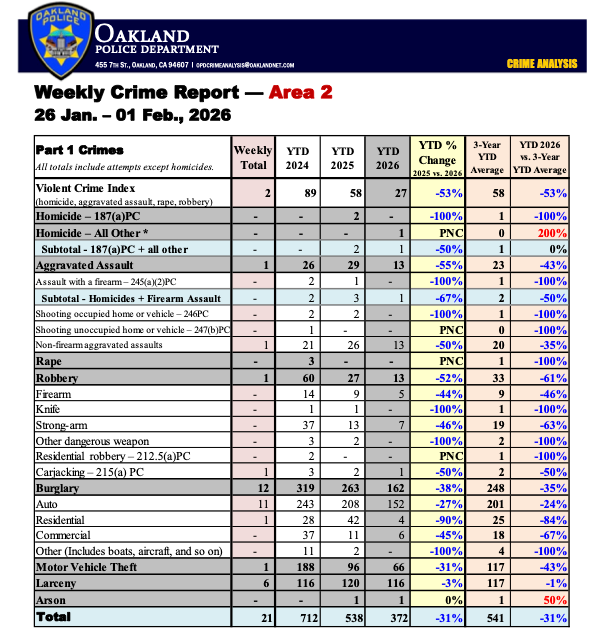
EDITORS NOTE: OPD’s Jan. 1–Feb. 1 year-to-date report shows the Violent Crime Index in Area 2 (which includes Rockridge) down 27 percent from last year and 31 percent below the three-year average. Year-to-date averages show aggravated assaults are down 43 percent, robberies 52 percent, and motor vehicle theft 31 percent. The area has recorded one homicide and one rape over the past three years. Auto break-ins remain high. See chart below (includes YTD totals):
Auto Crime Remains Stubborn
Auto burglaries continue to dominate neighborhood concerns. NCPC data for Beat 12Y show 70 car break-ins in December alone. Burke said patrols have increased around known hot spots such as Rockridge Market Hall. Many suspects are believed to come from outside Oakland, committing crimes and quickly fleeing via the freeway. The Rockridge District Association has approved new warning signage reminding visitors not to leave valuables in vehicles.
“Awareness counts for everything,” Burke said, noting that cars with tinted windows, out-of-state plates, or rental tags are often targeted.
The Reporting Gap
Under-reporting remains a challenge. Without a formal complaint, police cannot act — even if video evidence exists. Officers can now provide residents with a direct link to upload surveillance footage into OPD’s evidence system.
Longtime NCPC volunteer Karen Ivy compiles monthly crime data from OPD’s 90-day public database, organizing incidents into categories developed by the council: crimes against persons, property crimes, auto-related property crimes, quality-of-life offenses, and “other.”
She also clarified confusion over some of the entries labeled as homicides. Many are coded as “unexpected unexplained deaths” and are not confirmed homicides, so they are excluded from neighborhood tallies.
Prevention and Preparedness
Burke, reflecting on his 30 years with OPD, said morale matters. The department has about 680 officers but needs roughly 1,200. Five new academies are budgeted this year as the city works to rebuild staffing. Although staffing shortages have ended comprehensive home safety inspections, beat officers still advise residents on lighting, camera placement, and visibility improvements.
Wildfire prevention is also part of the safety discussion. California Public Resources Code 4291 requires 100 feet of defensible space around structures to the property line, though it does not address vegetation beyond parcel boundaries. Proposed East Bay vegetation rules have prompted debate on the issue and its impact on home owners.
Broader City Updates
Unger shared current fiscal highlights: lower municipal spending, higher revenues, rebounding home sales, and a successful bond sale to fund road paving and 2,500 affordable housing units. All Oakland fire stations are currently open, including the one at Jack London Square, which is now equipped with a new fireboat.
Oakland’s unhoused population is estimated at 6,000, with about 1,500 shelter beds available. The city is exploring temporary housing options, including motel conversions.
Unger reiterated that Oakland remains a sanctuary city and does not cooperate with federal immigration enforcement.
“We’re all doing the best we can,” Ivy said — a reminder that public safety depends as much on community engagement as city policy.
Public database crime reports: CrimeWatch Maps Past 90-Days | Open Data Portal.
Report a crime online: https://www.oaklandca.gov/services/report-a-crime-online
The next NCPC meeting is scheduled for 7pm, April 9, at the Rockridge Library conference room.


