

On a rainy evening on March 31, more than 60 Rockridge residents gathered at the College Avenue Presbyterian Church to learn about the proposed senior housing development at 6230 Claremont.
Leila Gough opened the meeting by introducing the Rockridge Neighbors for Sensible Housing (RNSH) steering committee and outlining the evening’s agenda: a technical presentation, a Q&A session, and a call to action for community involvement. The group has an online petition that has already collected 1,184 signatures.
A Commitment to Sensible Growth
The committee opened by clarifying its stance: We are proponents of housing. We support more affordable housing, and specifically, more affordable senior housing. However, the project at 6230 Claremont is a luxury senior housing development. While we want to see this site developed, it must be done responsibly and within the bounds of the law.
The Technical Challenge: Density Calculations
The primary point of contention involves how the building’s size is calculated:
- Zoning Limits: The site is currently zoned for a maximum height of 55 feet.
- State Density Bonus: While laws allow developers to exceed local limits in exchange for affordable units or senior care facilities, RNSH believes the developer’s baseline calculations are flawed.
- The Discrepancy: The developer claims they are requesting a 20% increase. However, our technical review suggests their “base density” is overstated. This error inflates every subsequent calculation, leading to a proposed height and footprint that far exceeds what should be legally permitted.
It is now up to city staff, the Planning Commission, and the Oakland City Council to ensure the developer adheres to local regulations.
Visualizing the Scale
Rockridge community members presented a visual analysis of the developer's plan. There were audible gasps from the audience when the scale of the proposed building was shown in relation to the existing neighborhood.
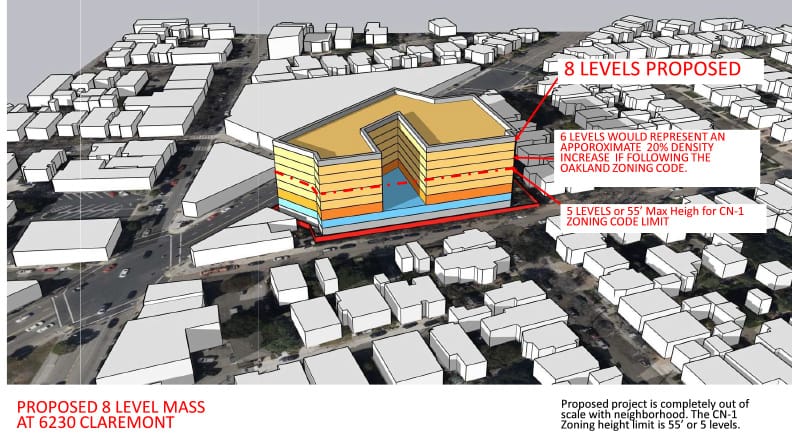
The proposal includes 203 units. For context, a survey of similar independent senior living buildings in Berkeley shows an average of 94 to 127 units. This project is nearly double the size of its local peers. To achieve this density, the developers are requesting several waivers:
Height: Requesting 84' 10" (8 floors) where 55' is the limit.
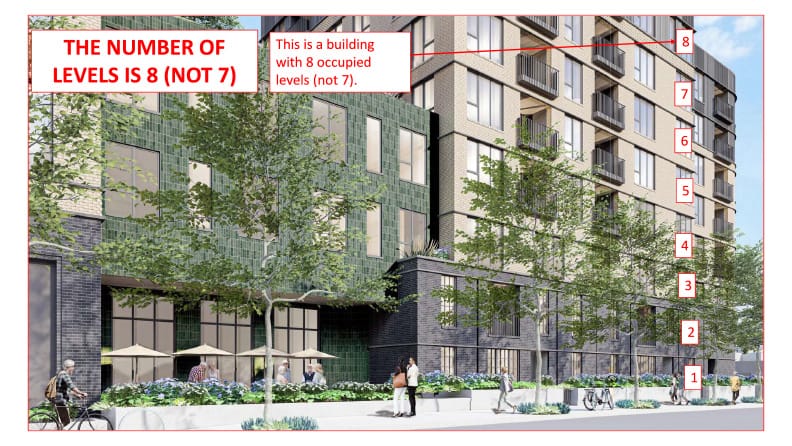
Step-backs: Encroaching on neighboring yards with a massive block wall just 15 feet from property lines on Auburn and Florio.
Other Waivers: Encompassing property lines and ground-level transparency.
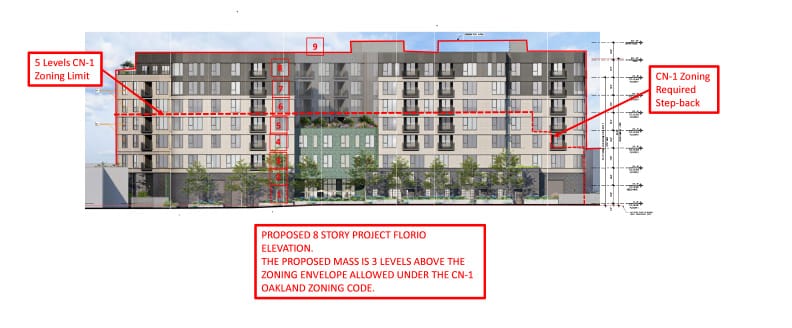
In total, these requests represent a 120% density increase over standard zoning.
Community Concerns and Next Steps
The presentation was followed by a spirited Q&A. Neighbors raised critical questions, including:
- Has a financial feasibility analysis been conducted to determine the minimum number of units required for the project’s viability?
- How was this specific design selected for this site?
- What is the long-term strategy for neighborhood integration?
The meeting also saw significant frustration directed at Council Member Zac Unger regarding his recent proposal regarding SB-79, leaving many residents questioning his role as a representative of neighborhood interests.
Tory Griffith concluded the meeting by outlining how neighbors can help:
1. Write to City Planning staff to voice your concerns.
2. Contact Council Member Zac Unger directly.
3. Attend upcoming Planning Commission meetings.
4. Spread the word to ensure your neighbors are informed and involved.
5. Visit WWW.6230claremontseniorhousing.com


