


Stepping into our 350-square-foot apartment, your eye is immediately drawn to the view of Rockridge at the base of the Oakland Hills. Our bay window opens to a 180-degree panorama, balancing long, sweeping vistas with a cozy corner that invites slower, ground-level looking.
Living on the second floor means there’s no need to hide from the street with curtains or shades. The view is always present, carrying us from dawn to dusk and attuning us to the daily cycles of the earth.
Instead of anchoring the room around a large flat-screen TV or decorative objects, we placed our dining table directly in front of the bay window. From this simple vantage point, we witness the quiet rhythms of flora, fauna, and everyday street life unfolding below. This gives us a unique opportunity to interweave our lives with Rockridge’s ecosystem. It’s a daily reminder that we are connected to place not as spectators, but as participants in its ongoing life.
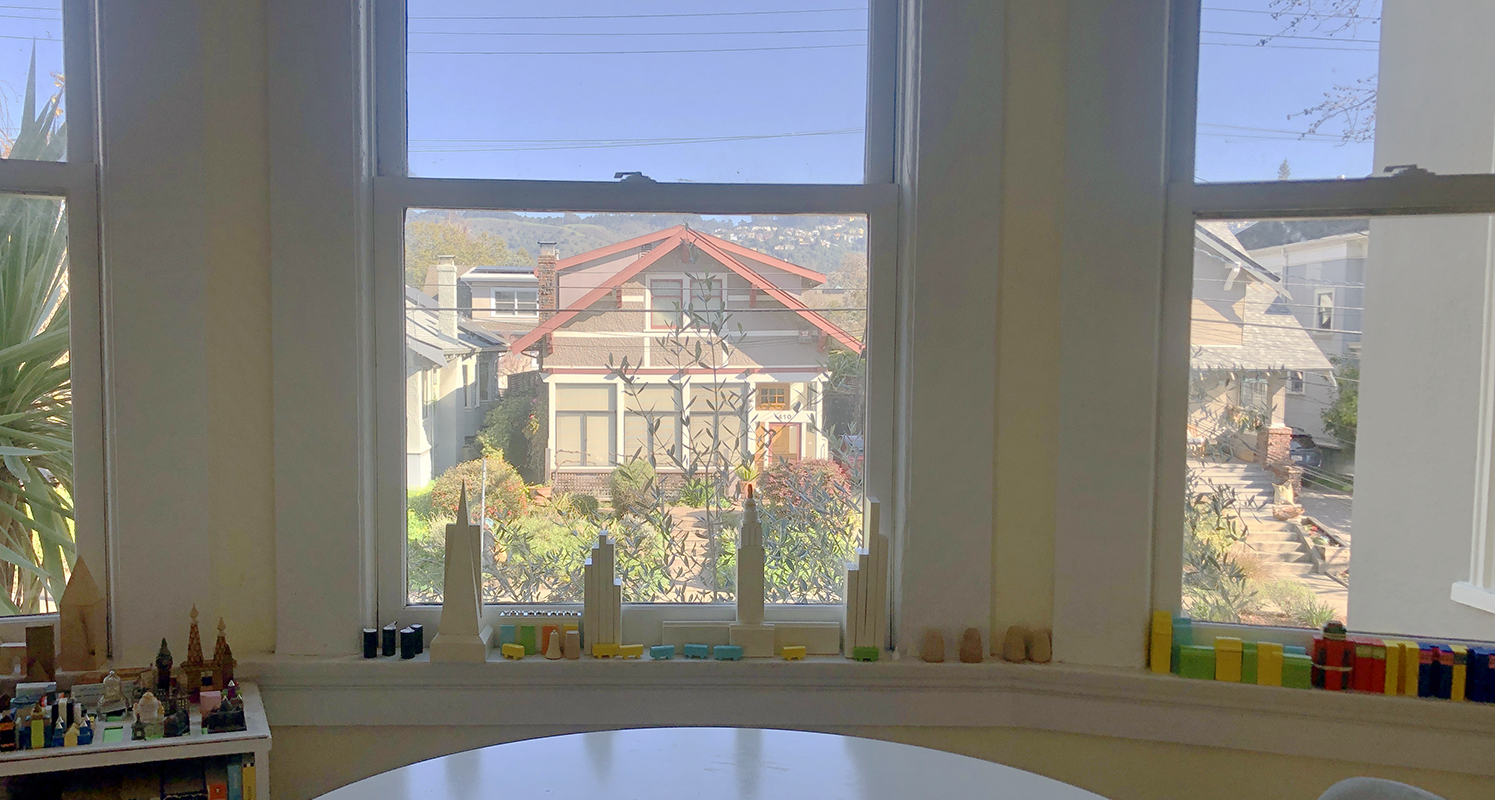
The sky fills our view with sun or clouds each day, while plants, animals, and humans animate the ground below. At dawn on a clear day, soft pink and blue light pours in from the east, tracing the edges of gable roofs across the street and the skeletal branches of winter trees. This light moves to illuminate the front façades and gardens opposite us. By late afternoon, it turns golden, and later we watch the fog rolling in against the hills.
At night, especially after rain, the street is devoid of color and takes on a still, film-noir quality, as shadows deepen and bounce light in unexpected ways. On windy days, olive branches and cordyline sway and shudder, setting the entire view in motion.
Living in a mediterranean climate, we’re lucky to enjoy seasonal blooms like California poppies, joined by lavender from the south of France and a variety of blooming orange flowers from South Africa, South America, Mexico, and Australia. And if we’re lucky, we might catch migrating monarchs flying through. These subtle shifts in color continually remake the landscape throughout the year. Even so, the bright green leaves of the sweetgum trees eventually turn red and drop, gently reminding us that summer has passed.
Animals Abound
Migrating birds rattle the birch trees on their way north or south, or disappear into a sweetgum, announcing their presence through sound alone. Others quietly pillage the small olives or cordyline seeds.
It’s the crows, however, that give us the most entertainment, with their constant mix of grating caws, coos, and clicks, and the occasional shiny token left in the birdbath. We watch them peck at a plastic bag of food. They stake out the treetops, guarding the neighborhood from hawks, swooping and diving like World War I airplanes in pursuit. Every so often, we’re lucky enough to receive a visit from a woodpecker or an owl.
A murder of crows hold an early evening gathering on Shafter. Photo: Anna L. Marks
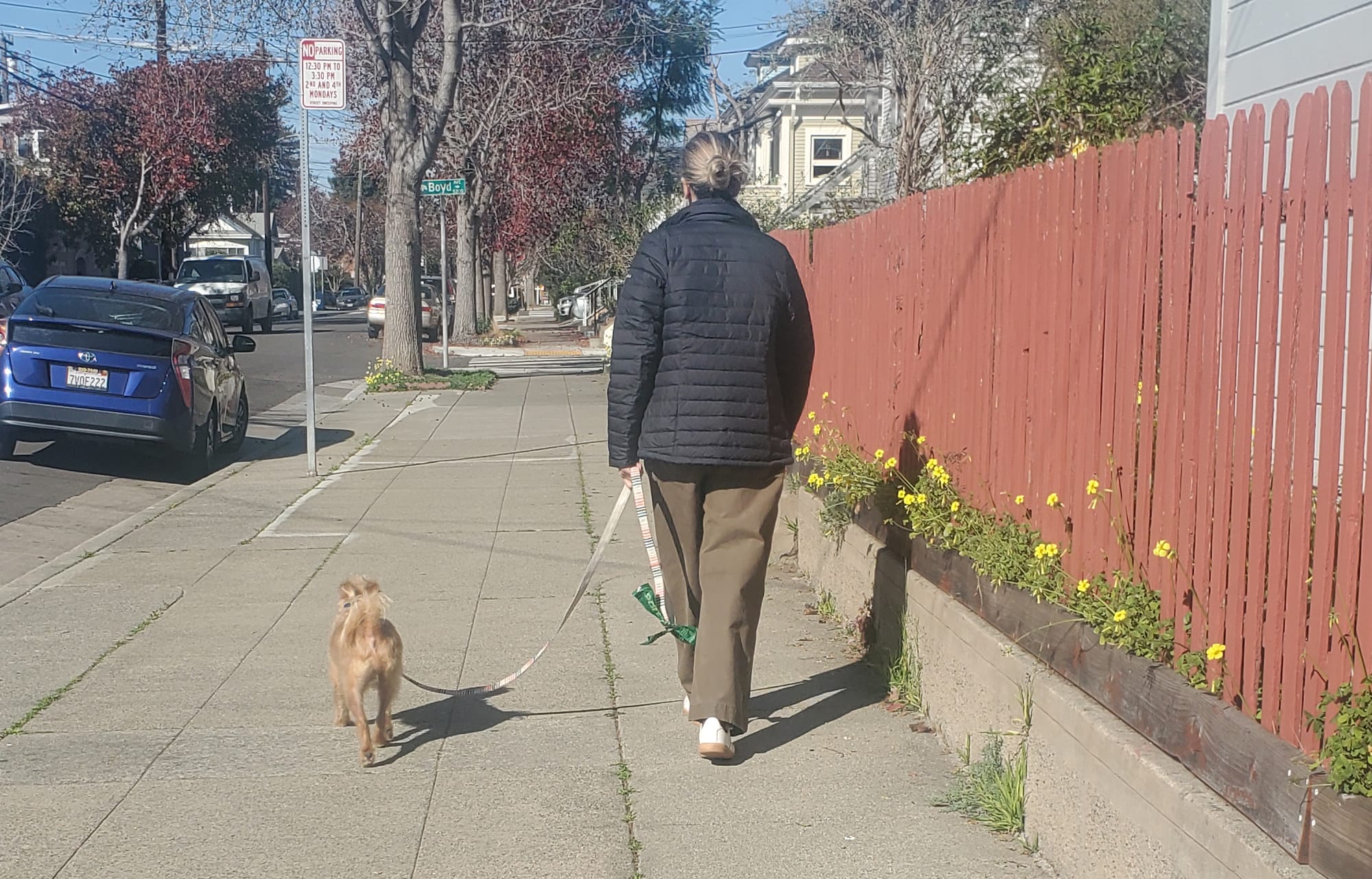
Like clockwork, there is always a parade of people walking their dogs throughout the day and night.
People participate simply by being present—sometimes knowingly, sometimes unconsciously—yet always connecting to space. This is not a program, nor a spectacle. It is the ordinary, repeated interactions that matter most: neighbors taking out the trash, nannies walking children to Frog Park, residents heading to and from Market Hall or BART.
Who walks, how they walk, and whom they walk with reveals a quiet sociology of the street. Women walking close, absorbed in conversation. A gaggle of kids drifting toward the library. Then the unexpected encounters: a man who backpacked through Spain during the filming of Doctor Zhivago and was hired as an extra, or a recent MIT graduate casually taking the measure of the neighborhood. Soon it will be my turn to walk.
This kind of ecosystem balance is hard to find in most cities because urban planners, myself included, are trained to design for highest and best use rather than for relationship-building. Housing is conceived in units, transportation is defined by cars, and people’s lives are shaped around their careers.
It is our bay window, and the choice to look out, that creates a deep connection to place. These small, everyday moments bind people to space, give it meaning, and quietly anchor us here.
Here, the pace of life is not set by how much one can accomplish in a day, by traffic, or by the politics of the world, but by the sensory details unfolding just outside our window.


